Cloud-Based BIM Collaboration Continues to Grow Among Global AEC Firms
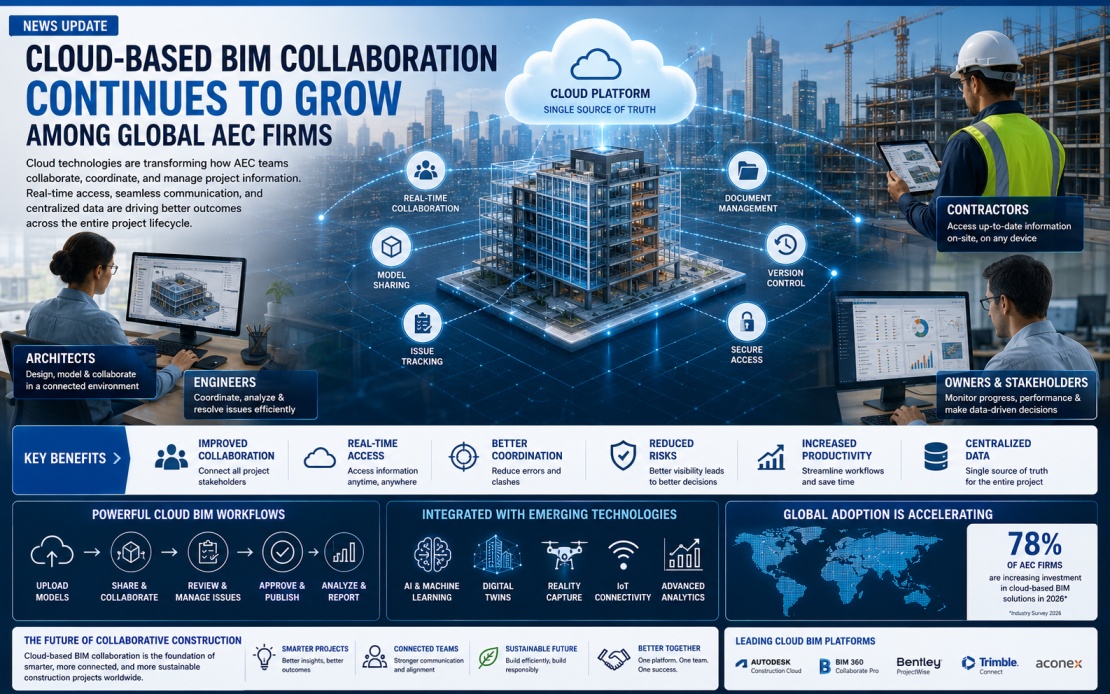
Cloud-based collaboration platforms continue to transform how Architecture, Engineering, and Construction (AEC) firms manage Building Information Modeling (BIM) projects. Organizations worldwide are increasingly adopting cloud technologies to improve project coordination, support remote teams, and centralize project information.
As digital construction becomes more data-driven, cloud BIM environments are helping project stakeholders collaborate more effectively across the entire project lifecycle.
Industry analysts report growing investment in cloud collaboration technologies as firms seek greater efficiency, improved information management, and enhanced project visibility.
Why Cloud BIM Adoption is Growing
Modern construction projects often involve architects, engineers, contractors, consultants, owners, and facility managers working from different locations.
Traditional file-sharing methods can create challenges related to version control, information accessibility, and project coordination.
Cloud-based BIM platforms help solve these issues by providing a centralized environment where project teams can access up-to-date information in real time.
Key drivers of adoption include:
- Remote project collaboration.
- Real-time information sharing.
- Improved project visibility.
- Centralized document management.
- Enhanced coordination workflows.
- Growing digital transformation initiatives.
Role of Cloud Platforms in BIM
Cloud platforms serve as a Common Data Environment (CDE), allowing project teams to store, manage, and exchange information from a single source of truth.
Popular cloud-based BIM platforms include:
- Autodesk Construction Cloud (ACC).
- BIM Collaborate Pro.
- Bentley ProjectWise.
- Aconex.
- Trimble Connect.
These platforms help reduce information silos and improve project communication.
Benefits for Global AEC Firms
Cloud collaboration provides several advantages for organizations managing large and complex projects.
- Improved team collaboration.
- Faster access to project information.
- Reduced document duplication.
- Enhanced version control.
- Better coordination between disciplines.
- Improved project transparency.
These benefits contribute directly to improved project delivery and reduced project risks.
Supporting Remote and Hybrid Work
The rise of remote and hybrid work environments has accelerated demand for cloud-based project delivery solutions.
Cloud BIM platforms allow project stakeholders to access project information securely from virtually any location.
This flexibility enables organizations to:
- Support distributed teams.
- Improve workforce productivity.
- Reduce communication delays.
- Maintain project continuity.
As workforce models continue evolving, cloud collaboration is expected to remain a critical technology.
Improving BIM Coordination
Effective BIM coordination depends on accurate and timely information exchange.
Cloud platforms provide tools that support:
- Model sharing.
- Issue tracking.
- Clash coordination.
- Design reviews.
- Project reporting.
These capabilities help project teams identify and resolve issues more efficiently before they impact construction activities.
Integration with Emerging Technologies
Cloud BIM environments are increasingly integrating with other digital construction technologies.
Examples include:
- Artificial Intelligence.
- Digital Twins.
- Reality Capture.
- IoT Systems.
- Advanced Analytics.
These integrations allow organizations to gain deeper insights into project performance and asset operations.
Cybersecurity and Data Management
As cloud adoption increases, organizations continue focusing on data security and information management.
Leading cloud platforms provide advanced security features such as:
- User access controls.
- Data encryption.
- Audit tracking.
- Backup systems.
- Permission management.
These measures help organizations protect critical project information while supporting secure collaboration.
Impact on Project Delivery
Cloud collaboration is helping organizations improve project performance through faster communication and more efficient workflows.
Potential project benefits include:
- Reduced coordination delays.
- Improved decision-making.
- Lower project risks.
- Enhanced stakeholder communication.
- Greater operational efficiency.
Many firms now view cloud collaboration as an essential component of modern BIM project delivery.
Industry Outlook
The global construction industry continues moving toward cloud-first strategies as organizations modernize their digital infrastructure.
Industry experts expect adoption rates to increase further as cloud platforms become more powerful and integrated with emerging technologies.
Future developments may include:
- AI-powered project insights.
- Real-time Digital Twin connectivity.
- Automated issue management.
- Advanced project analytics.
- Enhanced mobile collaboration.
These innovations are expected to further strengthen the role of cloud technology within BIM workflows.
Conclusion
Cloud-based BIM collaboration is rapidly becoming the standard approach for project delivery among global AEC firms. By providing centralized information management, real-time collaboration, and improved coordination capabilities, cloud platforms are helping organizations manage increasingly complex projects more effectively.
As digital construction continues evolving, cloud collaboration will remain a critical technology supporting BIM, Digital Twins, Artificial Intelligence, and future smart construction workflows.
Organizations that embrace cloud BIM technologies today will be better positioned to improve efficiency, reduce project risks, and remain competitive in an increasingly digital construction industry.