Top Construction Technology Trends Shaping BIM in 2026
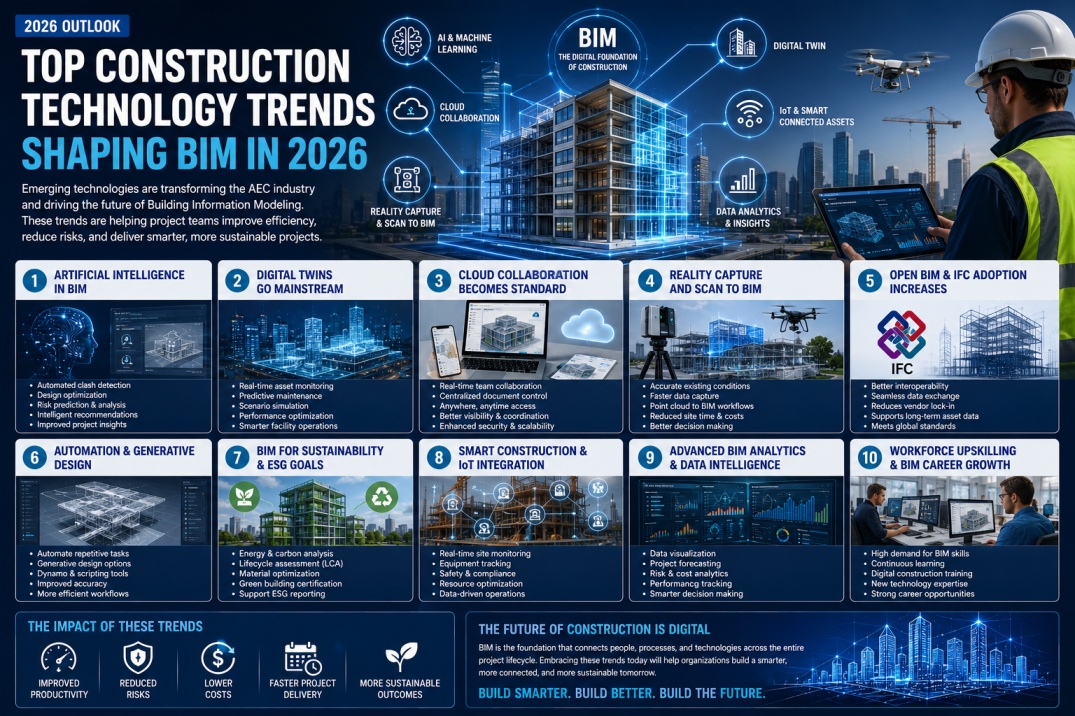
The Architecture, Engineering, and Construction (AEC) industry is experiencing a new wave of digital transformation as emerging technologies continue reshaping project delivery workflows. Building Information Modeling (BIM) remains a key foundation of this transformation, enabling organizations to integrate design, construction, and operations into a connected digital ecosystem.
As we move through 2026, several technology trends are accelerating BIM adoption and changing how project teams collaborate, coordinate, and manage information throughout the asset lifecycle.
From Artificial Intelligence to Digital Twins, these innovations are helping organizations improve productivity, reduce project risks, and support smarter decision-making.
1. Artificial Intelligence Becomes More Integrated with BIM
Artificial Intelligence (AI) is rapidly becoming one of the most influential technologies in construction.
AI-powered tools are increasingly being used to:
- Automate clash detection.
- Analyze project risks.
- Improve scheduling.
- Support design optimization.
- Generate project insights.
Rather than replacing BIM professionals, AI is helping teams automate repetitive tasks and focus on higher-value activities.
2. Digital Twins Continue Expanding
Digital Twin adoption is accelerating across buildings, infrastructure projects, and Smart Cities.
By connecting BIM models with real-time operational data, Digital Twins provide a dynamic representation of physical assets.
Organizations are using Digital Twins for:
- Facility management.
- Asset monitoring.
- Predictive maintenance.
- Energy optimization.
- Infrastructure management.
Many industry experts consider Digital Twins one of the fastest-growing areas within digital construction.
3. Cloud-Based BIM Collaboration Becomes Standard
Cloud collaboration platforms continue gaining popularity among project teams worldwide.
Solutions such as Autodesk Construction Cloud and BIM Collaborate allow stakeholders to access project information from virtually anywhere.
Benefits include:
- Real-time collaboration.
- Centralized information management.
- Improved version control.
- Faster issue resolution.
- Enhanced project visibility.
Cloud technology is helping organizations manage increasingly complex projects more efficiently.
4. Reality Capture and Scan-to-BIM Growth
Laser scanning, LiDAR, drone surveys, and photogrammetry technologies continue transforming existing-condition documentation.
Reality capture workflows support:
- Renovation projects.
- Infrastructure documentation.
- Facility management.
- Historic preservation.
- Digital Twin creation.
The growing adoption of Point Cloud to BIM workflows is improving project accuracy while reducing manual surveying effort.
5. Open BIM and IFC Adoption Increases
Organizations are increasingly embracing Open BIM standards to improve interoperability between software platforms.
The Industry Foundation Classes (IFC) standard continues playing an important role in enabling seamless data exchange across project stakeholders.
Open BIM adoption helps:
- Reduce vendor dependency.
- Improve collaboration.
- Enhance information exchange.
- Support long-term asset management.
Many public-sector projects now require Open BIM workflows as part of procurement requirements.
6. Automation and Generative Design
Automation technologies are helping BIM teams improve productivity and reduce repetitive work.
Tools such as Dynamo and Generative Design allow users to automate workflows and explore multiple design options more efficiently.
Common applications include:
- Model automation.
- Design optimization.
- Parameter management.
- Data extraction.
- Documentation generation.
Automation continues reducing manual effort while improving consistency.
7. BIM for Sustainability and ESG Goals
Sustainability remains a major focus for the construction industry in 2026.
BIM technologies are helping organizations evaluate environmental performance and support sustainability objectives.
Applications include:
- Energy analysis.
- Carbon reduction planning.
- Lifecycle assessments.
- Material optimization.
- Green building certification support.
As environmental regulations become stricter, BIM's role in sustainability continues growing.
8. Smart Construction and IoT Integration
Internet of Things (IoT) technologies are increasingly being integrated with BIM environments.
Sensors installed throughout buildings and infrastructure provide real-time operational data that supports better asset management.
Benefits include:
- Performance monitoring.
- Predictive maintenance.
- Operational optimization.
- Safety improvements.
- Energy management.
IoT integration is helping bridge the gap between construction and facility operations.
9. Advanced BIM Analytics and Data Intelligence
Construction organizations are collecting more data than ever before.
Advanced analytics platforms are helping teams transform this information into actionable insights.
Key applications include:
- Risk analysis.
- Project forecasting.
- Performance monitoring.
- Resource optimization.
- Decision support.
Data-driven decision-making is becoming a competitive advantage for leading construction firms.
10. Workforce Upskilling and BIM Career Growth
As construction technology evolves, demand for skilled BIM professionals continues increasing.
Organizations are investing heavily in workforce development and digital construction training.
High-demand roles include:
- BIM Manager.
- BIM Coordinator.
- Digital Twin Specialist.
- Construction Technology Consultant.
- Information Manager.
Professionals with expertise in BIM, AI, cloud collaboration, and Digital Twins are expected to remain highly sought after throughout the industry.
Industry Outlook for 2026
The construction industry is moving toward a future where BIM serves as the central platform connecting design, construction, operations, and asset management.
Organizations that embrace emerging technologies are likely to gain advantages through improved efficiency, better collaboration, reduced project risks, and enhanced project delivery outcomes.
The combination of BIM, AI, Digital Twins, automation, cloud collaboration, and advanced analytics is creating a new era of digital construction.
Conclusion
The top construction technology trends shaping BIM in 2026 demonstrate how rapidly the industry is evolving. Technologies such as Artificial Intelligence, Digital Twins, Open BIM, cloud collaboration, reality capture, and automation are transforming traditional workflows and creating new opportunities for innovation.
As organizations continue investing in digital transformation, BIM will remain a critical foundation supporting smarter, more connected, and more sustainable construction projects worldwide.
For BIM professionals, staying informed about these trends is essential for remaining competitive and preparing for the future of digital construction.