How Artificial Intelligence is Transforming Clash Detection Workflows in BIM
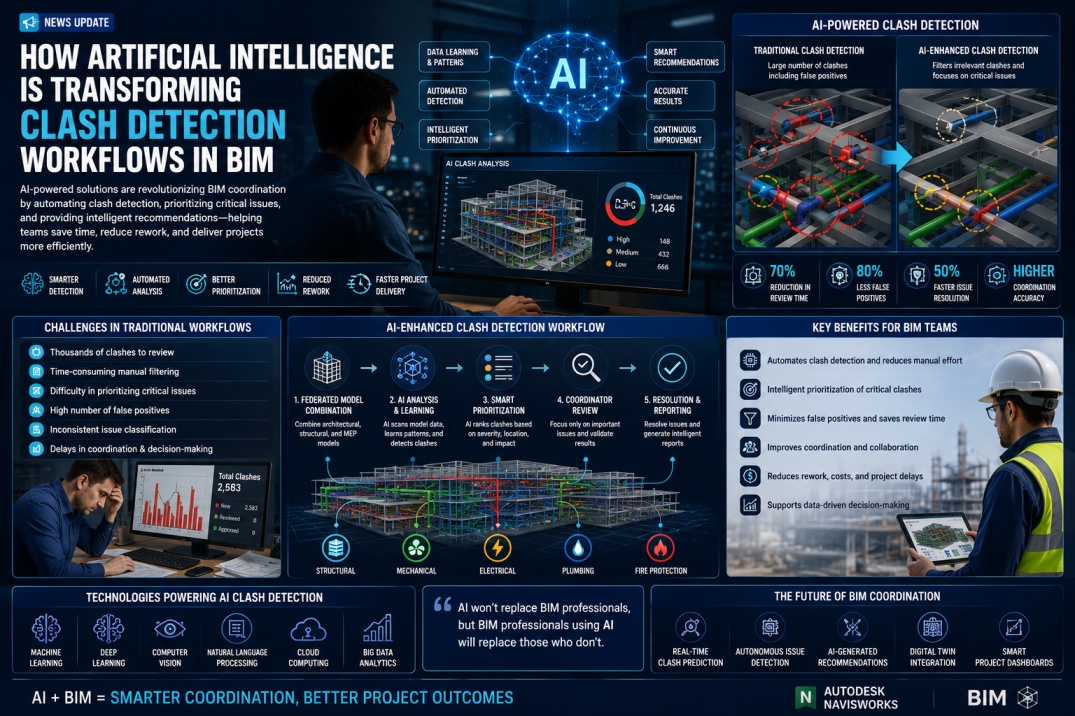
Artificial Intelligence (AI) is rapidly becoming one of the most influential technologies in the Architecture, Engineering, and Construction (AEC) industry. Among its many applications, AI-powered clash detection is emerging as a significant advancement for BIM coordination workflows.
Traditional clash detection processes require BIM Coordinators to review large numbers of conflicts generated from federated project models. On complex projects, clash reports can contain thousands of issues, making manual review time-consuming and challenging.
AI technologies are helping address this challenge by automatically analyzing clash data, identifying critical issues, and supporting faster decision-making throughout the coordination process.
What is Clash Detection?
Clash detection is the process of identifying conflicts between building systems before construction begins.
Using software such as Autodesk Navisworks and BIM coordination platforms, project teams combine architectural, structural, mechanical, electrical, plumbing, and fire protection models into a single environment.
The software then identifies physical conflicts that could create construction problems if left unresolved.
Common Clash Examples
- HVAC ducts passing through structural beams.
- Pipes intersecting cable trays.
- Electrical conduits conflicting with ceilings.
- Mechanical equipment blocking maintenance access.
- Structural components interfering with MEP systems.
Identifying these issues before construction reduces costly rework and project delays.
Challenges with Traditional Clash Detection
While clash detection has been a standard BIM practice for many years, traditional workflows often present challenges.
- Large volumes of clash results.
- Manual issue review.
- Difficulty prioritizing conflicts.
- Time-consuming coordination meetings.
- Inconsistent issue classification.
On major projects, BIM Coordinators may spend significant time filtering clashes and determining which issues require immediate attention.
How AI is Changing Clash Detection
AI introduces automation and intelligence into the clash detection process.
Rather than simply identifying geometric conflicts, AI systems can analyze project data and determine which clashes are most important based on project context.
This allows BIM teams to focus on resolving high-priority issues instead of reviewing every clash manually.
Automated Clash Prioritization
One of the most valuable AI capabilities is automated clash prioritization.
AI algorithms can evaluate:
- Clash severity.
- Project location.
- Construction phase.
- System importance.
- Historical project data.
Based on these factors, AI can rank clashes according to their potential impact on project delivery.
This helps BIM Coordinators focus their efforts on the most critical coordination issues.
Reducing False Positives
Traditional clash detection often generates large numbers of false positives.
These may include acceptable overlaps, intentional design conditions, or non-critical conflicts.
AI systems can learn from previous project decisions and automatically identify clashes that do not require action.
Reducing false positives helps teams spend less time reviewing irrelevant issues.
Intelligent Issue Classification
AI-powered platforms can automatically categorize clashes based on discipline, system type, location, and severity.
Examples include:
- Structural clashes.
- Mechanical clashes.
- Electrical clashes.
- Access conflicts.
- Maintenance clearance issues.
Automated classification improves reporting and coordination workflows.
Supporting BIM Coordinators
AI is not intended to replace BIM Coordinators. Instead, it acts as an intelligent assistant that helps teams work more efficiently.
By automating repetitive tasks, BIM professionals can spend more time solving coordination problems and improving project outcomes.
Potential benefits include:
- Faster clash reviews.
- Improved coordination efficiency.
- Reduced manual effort.
- Better decision-making.
- More productive coordination meetings.
Integration with BIM Platforms
Many BIM software providers are actively exploring AI capabilities within their platforms.
Future integrations may include:
- AI-enhanced Navisworks workflows.
- Cloud-based coordination analysis.
- Automated issue tracking.
- Predictive clash detection.
- Intelligent project dashboards.
These capabilities could significantly improve project coordination efficiency.
Impact on Construction Projects
The construction industry continues facing pressure to improve productivity, reduce waste, and accelerate project delivery.
AI-powered clash detection supports these goals by helping teams identify problems earlier and resolve issues more efficiently.
Benefits may include:
- Reduced construction rework.
- Lower project costs.
- Improved schedule performance.
- Better coordination quality.
- Enhanced stakeholder communication.
Organizations adopting AI-enhanced BIM workflows may gain significant competitive advantages.
Future of AI in BIM Coordination
Industry experts believe AI will continue expanding across BIM coordination and digital construction workflows.
Future developments may include:
- Real-time clash prediction.
- Automated design recommendations.
- AI-generated coordination reports.
- Digital Twin integration.
- Predictive construction analytics.
As AI technologies mature, BIM teams can expect increasingly intelligent project coordination tools.
Conclusion
Artificial Intelligence is transforming clash detection from a purely geometric review process into a smarter, data-driven coordination workflow.
By automating clash prioritization, reducing false positives, and supporting intelligent decision-making, AI helps BIM professionals improve project coordination while reducing manual effort.
Although human expertise remains essential, AI-powered tools are becoming valuable assistants that enable BIM Coordinators to work more efficiently and deliver higher-quality project outcomes.
As digital construction technologies continue evolving, AI-enhanced clash detection is expected to become a standard feature of future BIM coordination workflows.