Digital Twins Adoption Accelerates Across Smart City Projects Worldwide
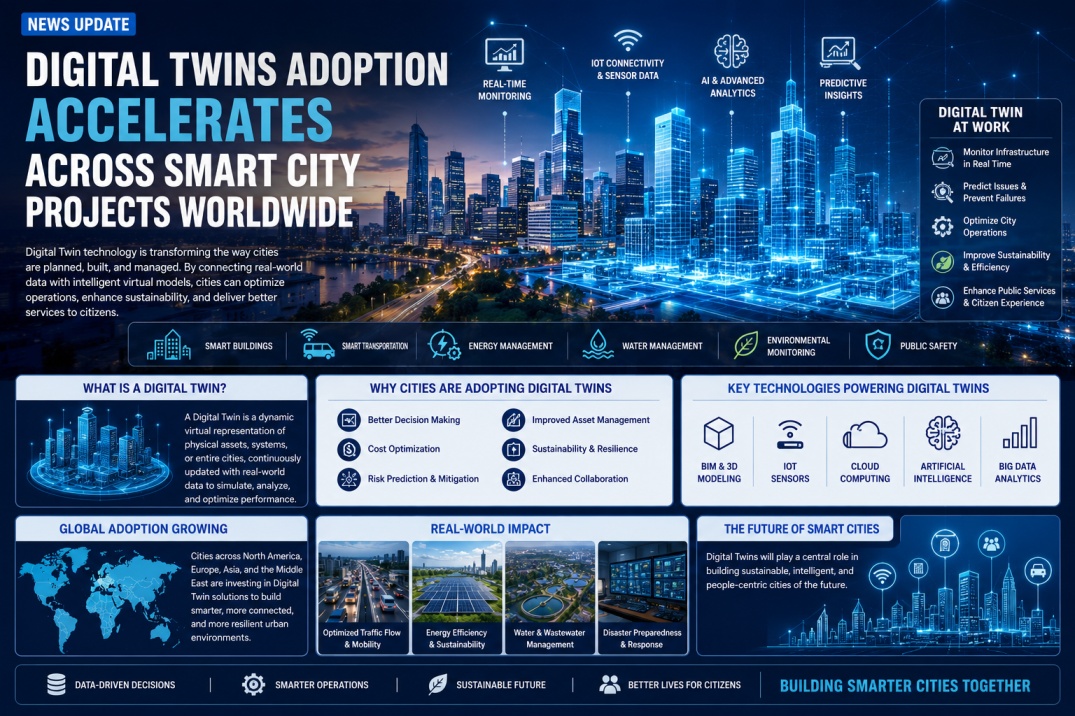
Digital Twin technology is gaining significant momentum across Smart City projects worldwide as governments and urban development agencies seek more efficient ways to manage infrastructure, improve public services, and support sustainable growth.
By creating virtual representations of physical assets, infrastructure networks, and entire cities, Digital Twins enable stakeholders to monitor, analyze, and optimize urban environments using real-time data and advanced analytics.
Industry experts believe Digital Twins will become one of the most important technologies driving the future of smart urban development over the next decade.
What is a Digital Twin?
A Digital Twin is a virtual representation of a physical asset, building, infrastructure system, or city that is continuously updated using real-world data.
Unlike traditional 3D models, Digital Twins integrate information from sensors, IoT devices, BIM models, and operational systems to create a dynamic digital environment.
This allows city managers and stakeholders to monitor performance, predict issues, and make better decisions based on accurate and up-to-date information.
Growing Demand for Smart Cities
Rapid urbanization continues to place increasing pressure on cities around the world. Growing populations require better transportation systems, utilities, public services, and sustainable infrastructure.
To address these challenges, governments are investing in Smart City technologies that improve efficiency, resilience, and quality of life.
Digital Twins have emerged as one of the most promising solutions because they provide a comprehensive view of urban operations and infrastructure performance.
How Digital Twins Support Smart Cities
Digital Twins help city planners and infrastructure managers understand how assets perform in real-world conditions.
Applications include:
- Infrastructure monitoring.
- Traffic management.
- Energy optimization.
- Water network management.
- Public safety planning.
- Environmental monitoring.
- Asset lifecycle management.
By providing real-time visibility into city operations, Digital Twins support more informed decision-making.
BIM as the Foundation of Digital Twins
Building Information Modeling (BIM) plays a critical role in Digital Twin development.
BIM models provide the structured information and geometry needed to create digital representations of buildings and infrastructure assets.
When combined with IoT sensors and operational data, BIM models evolve into intelligent Digital Twins capable of supporting real-time analysis and monitoring.
This connection between BIM and Digital Twins is becoming increasingly important in modern urban development projects.
Infrastructure Management Benefits
One of the primary reasons Digital Twin adoption is accelerating is its ability to improve infrastructure management.
Infrastructure owners can use Digital Twins to:
- Monitor asset performance.
- Predict maintenance requirements.
- Reduce downtime.
- Optimize resource allocation.
- Extend asset lifespan.
These capabilities help organizations improve operational efficiency while reducing maintenance costs.
Supporting Sustainability Goals
Many cities have established ambitious sustainability and carbon reduction targets.
Digital Twins can help achieve these goals by providing detailed insights into:
- Energy consumption.
- Building performance.
- Carbon emissions.
- Water usage.
- Environmental conditions.
This information enables city planners to identify opportunities for improving efficiency and reducing environmental impact.
Role of Artificial Intelligence
Artificial Intelligence is increasingly being integrated with Digital Twin platforms to enhance predictive capabilities.
AI algorithms can analyze large amounts of operational data and identify trends that may not be visible through traditional monitoring methods.
Potential applications include:
- Predictive maintenance.
- Traffic forecasting.
- Energy optimization.
- Infrastructure risk analysis.
- Emergency response planning.
The combination of AI and Digital Twins is expected to significantly improve Smart City operations in the coming years.
Global Adoption Continues to Expand
Cities across North America, Europe, Asia, and the Middle East are actively exploring Digital Twin technologies for urban planning and infrastructure management.
Many major Smart City programs now include Digital Twin initiatives as part of their long-term digital transformation strategies.
As technology costs continue decreasing and cloud infrastructure becomes more accessible, adoption rates are expected to increase further.
Challenges and Opportunities
Despite its benefits, Digital Twin implementation presents several challenges.
- Large data requirements.
- System integration complexity.
- Cybersecurity concerns.
- Initial technology investments.
- Data management requirements.
However, industry experts believe the long-term benefits outweigh these challenges, particularly for large-scale infrastructure and Smart City projects.
Future Outlook
The Digital Twin market is expected to experience substantial growth as cities continue investing in intelligent infrastructure and digital transformation initiatives.
Future developments may include:
- Real-time city-wide Digital Twins.
- Advanced AI-powered analytics.
- Autonomous infrastructure monitoring.
- Improved sustainability management.
- Enhanced citizen services.
These innovations are expected to help cities become more efficient, resilient, and responsive to changing urban needs.
Conclusion
The rapid adoption of Digital Twins across Smart City projects highlights the growing importance of data-driven urban management. By combining BIM, IoT, cloud technologies, and Artificial Intelligence, Digital Twins provide a powerful platform for improving infrastructure performance and supporting sustainable city development.
As governments and urban planners continue embracing digital transformation, Digital Twins are expected to play a central role in shaping the future of Smart Cities worldwide.
For BIM professionals and construction technology specialists, the growing Digital Twin ecosystem represents one of the most exciting opportunities in the future of digital construction and urban development.