buildingSMART Releases New IFC Updates to Improve Open BIM Collaboration
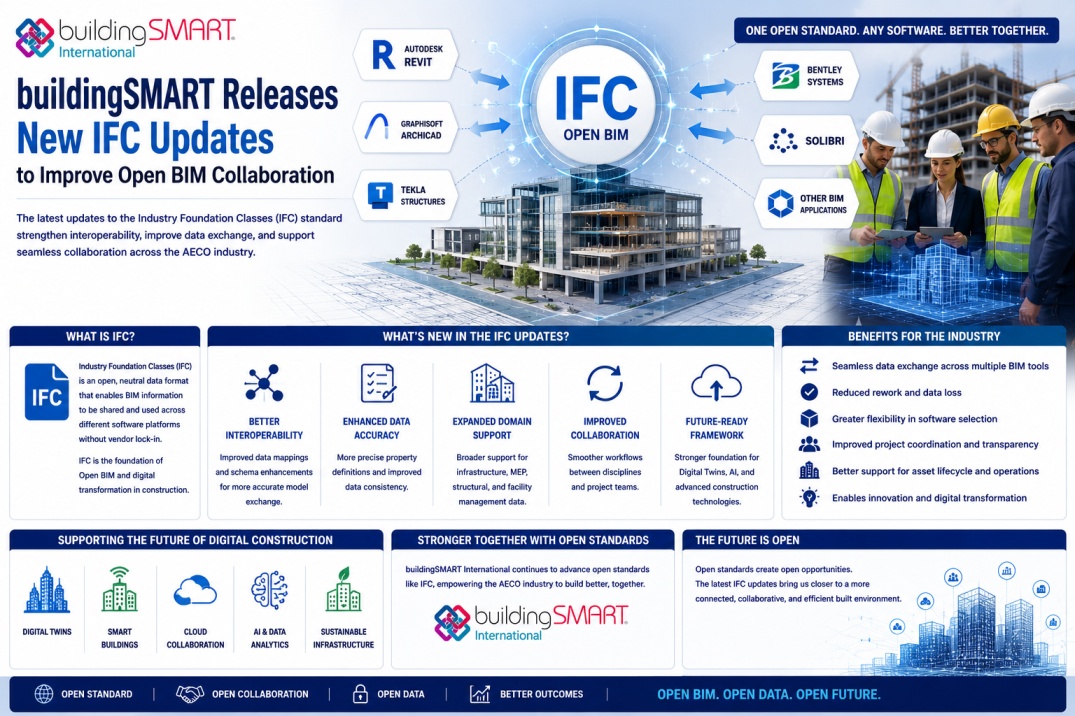
buildingSMART International has introduced important updates to the Industry Foundation Classes (IFC) standard, reinforcing its commitment to improving Open BIM collaboration across the global Architecture, Engineering, Construction, and Operations (AECO) sector.
As Building Information Modeling (BIM) adoption continues to grow worldwide, project teams increasingly rely on multiple software platforms throughout design, construction, and facility management workflows. Ensuring smooth data exchange between these platforms remains one of the industry's biggest challenges.
The latest IFC updates are designed to improve interoperability, support better information exchange, and reduce barriers between different BIM software ecosystems.
What is IFC?
Industry Foundation Classes (IFC) is an open and neutral data format developed by buildingSMART International. It allows BIM information to be exchanged between different software applications without requiring teams to work within a single vendor ecosystem.
IFC has become one of the most important foundations of Open BIM, enabling architects, engineers, contractors, and facility managers to collaborate more effectively regardless of which software tools they use.
Today, IFC is supported by many leading BIM platforms, including Autodesk Revit, Archicad, Tekla Structures, Bentley applications, Solibri, and numerous facility management solutions.
Why These Updates Matter
Construction projects often involve multiple stakeholders using different BIM software environments. Without standardized information exchange, project teams may experience data loss, coordination issues, and inefficient workflows.
The latest IFC enhancements aim to address these challenges by improving:
- Cross-platform BIM collaboration.
- Data consistency.
- Model exchange accuracy.
- Asset information management.
- Long-term data accessibility.
- Open BIM implementation.
These improvements help organizations maintain greater control over project information throughout the building lifecycle.
Improved Open BIM Collaboration
One of the primary goals of the updated IFC standard is to strengthen Open BIM workflows.
Open BIM allows project participants to select software tools that best fit their needs while maintaining the ability to exchange information effectively with other stakeholders.
The updated IFC framework supports more reliable communication between disciplines, helping reduce coordination issues and improving project transparency.
Benefits for BIM Professionals
The new IFC improvements may provide several advantages for BIM professionals and project teams.
- Improved model interoperability.
- More accurate information exchange.
- Reduced software dependency.
- Enhanced project collaboration.
- Better support for Digital Twins.
- Improved asset lifecycle management.
These benefits are particularly valuable for large multidisciplinary projects where multiple software platforms are used throughout project delivery.
Supporting Digital Construction
The construction industry continues its transition toward digital delivery methods, cloud collaboration platforms, and data-driven decision-making.
Open standards such as IFC play an important role in ensuring project information remains accessible and usable across different technologies and project phases.
As organizations increasingly adopt Digital Twins, Smart Buildings, and advanced asset management systems, interoperability standards become even more important.
Impact on Future BIM Workflows
Industry experts expect Open BIM adoption to continue growing as organizations seek greater flexibility and long-term control over project information.
The latest IFC updates support this trend by improving the reliability and quality of information exchange between software platforms.
Many public-sector projects and international infrastructure programs already require Open BIM standards, making IFC knowledge increasingly valuable for BIM professionals.
Looking Ahead
buildingSMART International continues to work with industry stakeholders, software developers, and construction organizations to advance BIM interoperability standards.
Future IFC developments are expected to support emerging technologies such as Artificial Intelligence, Digital Twins, Smart Cities, cloud collaboration, and advanced infrastructure management.
As digital construction evolves, IFC will remain a critical technology supporting Open BIM collaboration and enabling more connected project delivery workflows.
Conclusion
The latest IFC updates from buildingSMART International represent another important step toward improving Open BIM collaboration across the AECO industry.
By enhancing interoperability, data exchange, and long-term information accessibility, the updated standard helps project teams collaborate more effectively while maintaining flexibility in software selection.
For BIM professionals, understanding IFC and Open BIM principles is becoming increasingly important as digital construction continues advancing toward more connected and data-driven project environments.