Autodesk Construction Cloud Introduces New AI-Powered Project Insights
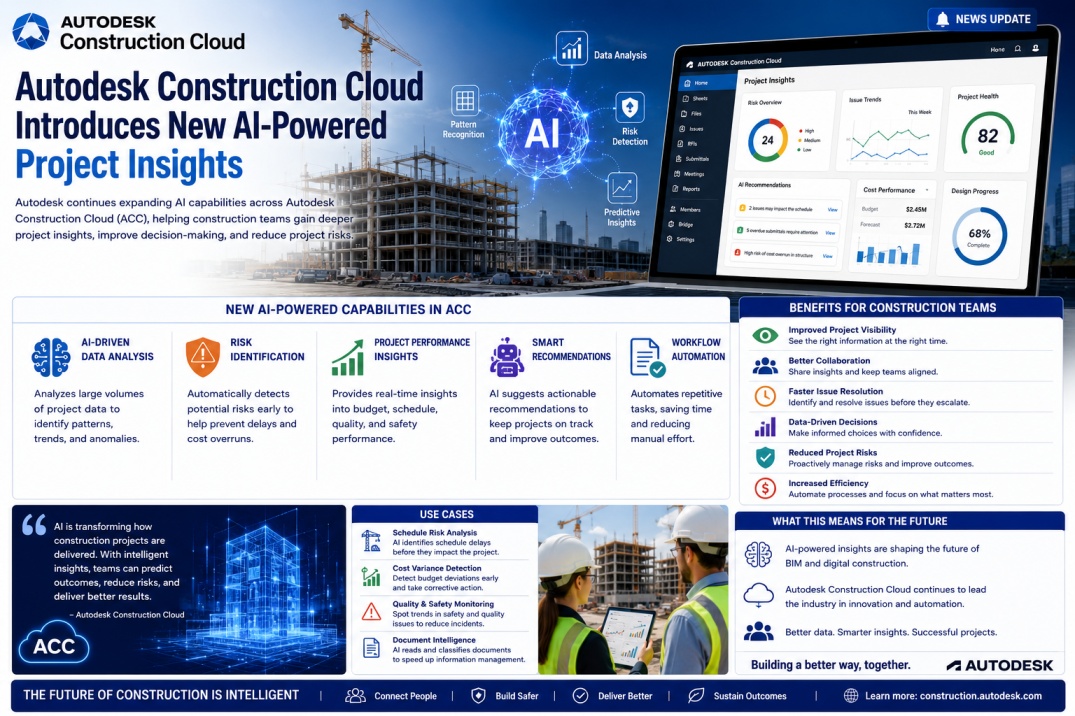
Autodesk is continuing its investment in Artificial Intelligence by introducing enhanced AI-powered project insights within Autodesk Construction Cloud (ACC). These new capabilities aim to help project teams better understand project performance, identify potential risks earlier, and make more informed decisions using data-driven intelligence.
As construction projects become increasingly complex, organizations generate massive amounts of information across design, coordination, scheduling, field operations, RFIs, submittals, and project documentation. Managing this information efficiently has become a major challenge for many Architecture, Engineering, and Construction (AEC) firms.
The latest AI enhancements in Autodesk Construction Cloud are designed to transform this data into meaningful insights that support better project delivery and operational efficiency.
How AI is Enhancing Autodesk Construction Cloud
Artificial Intelligence can analyze thousands of project records far faster than traditional manual methods. By identifying patterns and trends across project data, AI tools help teams uncover information that might otherwise go unnoticed.
The new AI-powered features within Autodesk Construction Cloud focus on:
- Project risk identification.
- Automated data analysis.
- Issue trend monitoring.
- Project performance insights.
- Workflow automation.
- Improved reporting capabilities.
These capabilities allow project stakeholders to spend less time reviewing data and more time making strategic decisions.
Smarter Project Decision-Making
One of the primary goals of AI-powered project insights is to improve decision-making throughout the project lifecycle.
By analyzing historical project information, current project performance, and ongoing field activities, AI systems can highlight areas that require attention before they become significant problems.
Project managers and BIM teams can use these insights to proactively address risks, improve communication, and maintain project schedules.
Benefits for BIM Teams
BIM Managers, BIM Coordinators, and project stakeholders may benefit significantly from AI-enhanced workflows.
Potential advantages include:
- Improved project visibility.
- Faster issue identification.
- Enhanced collaboration.
- Better coordination tracking.
- More accurate reporting.
- Reduced administrative workload.
As BIM projects continue generating larger volumes of data, AI-assisted project management tools are becoming increasingly valuable.
Supporting Digital Construction Workflows
The construction industry is rapidly embracing digital transformation through BIM, cloud collaboration, Digital Twins, and Artificial Intelligence.
Autodesk's latest AI initiatives align with this broader industry trend by helping project teams leverage data more effectively throughout design, construction, and operations.
AI-powered insights are expected to play an increasingly important role in supporting predictive analytics, automated issue management, and intelligent project monitoring in future construction workflows.
Industry Impact
Many industry experts believe that Artificial Intelligence will become a standard component of construction technology platforms over the next several years.
Organizations that adopt AI-enhanced project management tools may gain advantages through improved efficiency, better risk management, and more informed project decision-making.
As Autodesk continues integrating AI capabilities into Autodesk Construction Cloud, BIM professionals and construction teams can expect more intelligent workflows and greater automation opportunities in the future.
Looking Ahead
The integration of AI into Autodesk Construction Cloud reflects a growing shift toward data-driven project delivery. While AI is not expected to replace BIM professionals, it is increasingly becoming a valuable tool that helps teams work more efficiently and make better decisions.
As construction technology continues evolving, AI-powered insights, cloud collaboration platforms, and Digital Twin technologies are expected to play a major role in shaping the future of BIM and digital construction.