Top AI-Powered BIM Tools Transforming the Construction Industry in 2026
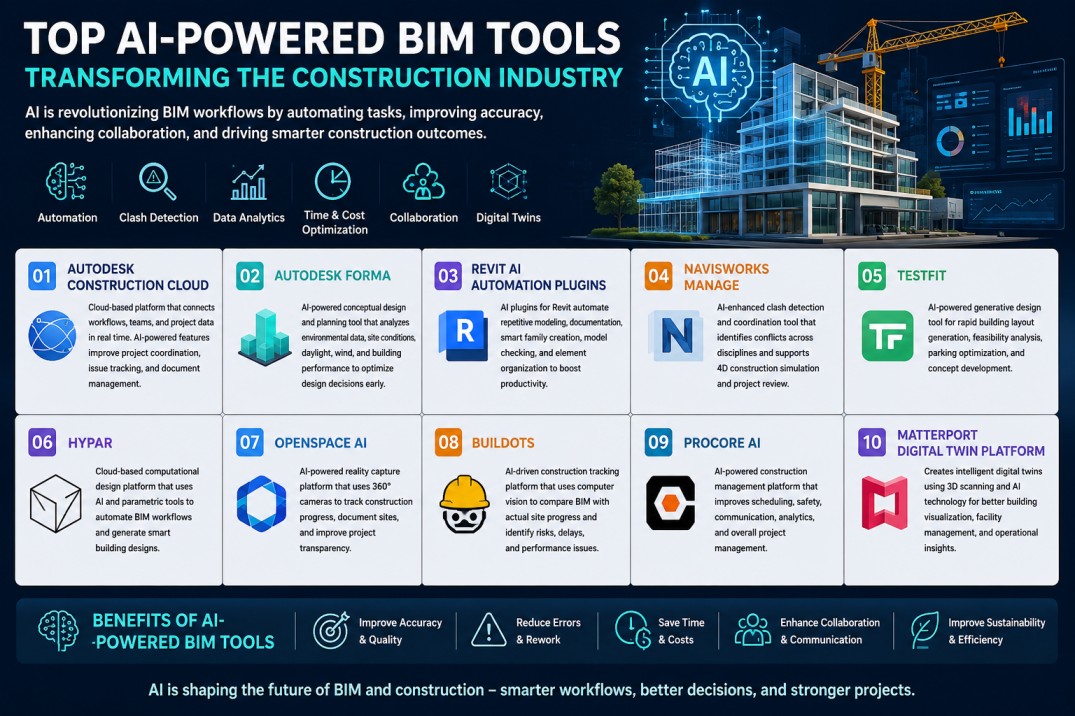
Artificial Intelligence is rapidly transforming Building Information Modeling (BIM) workflows across the architecture, engineering, and construction industry. AI-powered BIM tools are helping professionals automate repetitive tasks, improve project coordination, reduce errors, and optimize construction workflows.
Today, many BIM companies and construction professionals are using intelligent software platforms to improve design development, clash detection, project scheduling, cost estimation, site monitoring, and facility management.
Here are some of the most widely used AI-powered BIM tools transforming the construction industry in 2026.
1. Autodesk Construction Cloud
Autodesk Construction Cloud is one of the most popular cloud-based BIM collaboration platforms used by architects, engineers, contractors, and project managers worldwide.
The platform integrates AI-powered workflows for project coordination, issue tracking, document management, BIM collaboration, and construction management.
Main features include:
- Cloud-based BIM collaboration
- Project coordination workflows
- Issue tracking and management
- Document control systems
- Real-time team collaboration
Autodesk Construction Cloud helps improve communication between project teams and reduces project coordination issues.
2. Autodesk Forma
Autodesk Forma is an AI-powered conceptual design and planning platform developed to improve early-stage architectural workflows.
Forma uses Artificial Intelligence to analyze environmental data, site conditions, daylight performance, wind analysis, and building layouts to help architects make smarter design decisions.
Main features include:
- AI-powered conceptual design
- Environmental analysis tools
- Site planning workflows
- Daylight and wind analysis
- Real-time design optimization
Forma helps architects create more sustainable and optimized building designs during the conceptual stage.
3. Revit AI Automation Plugins
Many BIM professionals now use AI-powered Revit plugins to automate repetitive modeling and documentation tasks inside Autodesk Revit.
These intelligent plugins help improve productivity and reduce manual BIM workflows.
Main features include:
- Automated BIM documentation
- Smart model checking
- AI-assisted family creation
- Automatic element organization
- Workflow automation tools
AI-powered Revit tools help architects and BIM modelers work faster and improve project accuracy.
4. Navisworks Manage
Navisworks Manage is one of the most widely used BIM coordination and clash detection tools in the construction industry.
AI-powered workflows inside Navisworks help identify conflicts between architectural, structural, plumbing, HVAC, and electrical systems before construction begins.
Main features include:
- Clash detection workflows
- Construction coordination
- 4D scheduling simulation
- Model aggregation
- Project review tools
Navisworks helps reduce costly construction errors and improves multidisciplinary BIM coordination.
5. TestFit
TestFit is an AI-powered generative design platform used for rapid building layout generation and feasibility analysis.
The software helps architects and developers quickly evaluate multiple design options for residential, commercial, and mixed-use projects.
Main features include:
- AI-powered layout generation
- Feasibility analysis
- Parking optimization
- Site planning workflows
- Rapid concept development
TestFit significantly reduces conceptual design time and improves project planning workflows.
6. Hypar
Hypar is a cloud-based computational design platform focused on BIM automation and generative building design workflows.
The platform allows BIM professionals to automate repetitive design tasks using parametric and AI-powered workflows.
Main features include:
- Computational design automation
- Parametric BIM workflows
- Generative design systems
- Cloud-based BIM tools
- Automated space planning
Hypar helps improve BIM efficiency and automate repetitive design processes.
7. OpenSpace AI
OpenSpace AI is a construction site documentation and reality capture platform powered by Artificial Intelligence.
The platform automatically captures 360-degree site images and creates intelligent construction progress documentation.
Main features include:
- AI-powered site capture
- 360-degree project documentation
- Construction progress tracking
- Reality capture workflows
- Remote site monitoring
OpenSpace AI helps contractors improve construction monitoring and project transparency.
8. Buildots
Buildots is an AI-powered construction tracking and project analytics platform.
The system uses computer vision technology and AI algorithms to monitor construction progress and compare actual site conditions with BIM models.
Main features include:
- Construction progress tracking
- AI-powered site analytics
- BIM comparison workflows
- Project performance monitoring
- Delay analysis tools
Buildots helps contractors improve project visibility and reduce delays during construction.
9. Procore AI
Procore AI is an intelligent construction management platform designed to improve communication, scheduling, safety, and project coordination workflows.
The platform integrates AI-powered analytics and project management tools for construction teams.
Main features include:
- Construction project management
- AI-powered analytics
- Safety management tools
- Document control systems
- Team communication workflows
Procore AI helps improve project organization and construction management efficiency.
10. Matterport Digital Twin Platform
Matterport is one of the most popular digital twin and 3D reality capture platforms used in BIM and facility management workflows.
The platform creates intelligent digital twins of buildings using 3D scanning and AI-powered spatial analysis.
Main features include:
- Digital twin creation
- 3D building scanning
- Facility management workflows
- Virtual building walkthroughs
- Reality capture technology
Matterport helps architects, contractors, and facility managers improve building visualization and operational management.
As Artificial Intelligence continues evolving, AI-powered BIM tools are becoming increasingly important in modern construction workflows.
These technologies are helping the construction industry improve collaboration, automate repetitive tasks, reduce project risks, and create smarter digital construction workflows worldwide.