AI-Powered Revit Add-ins Gain Popularity Among BIM Professionals
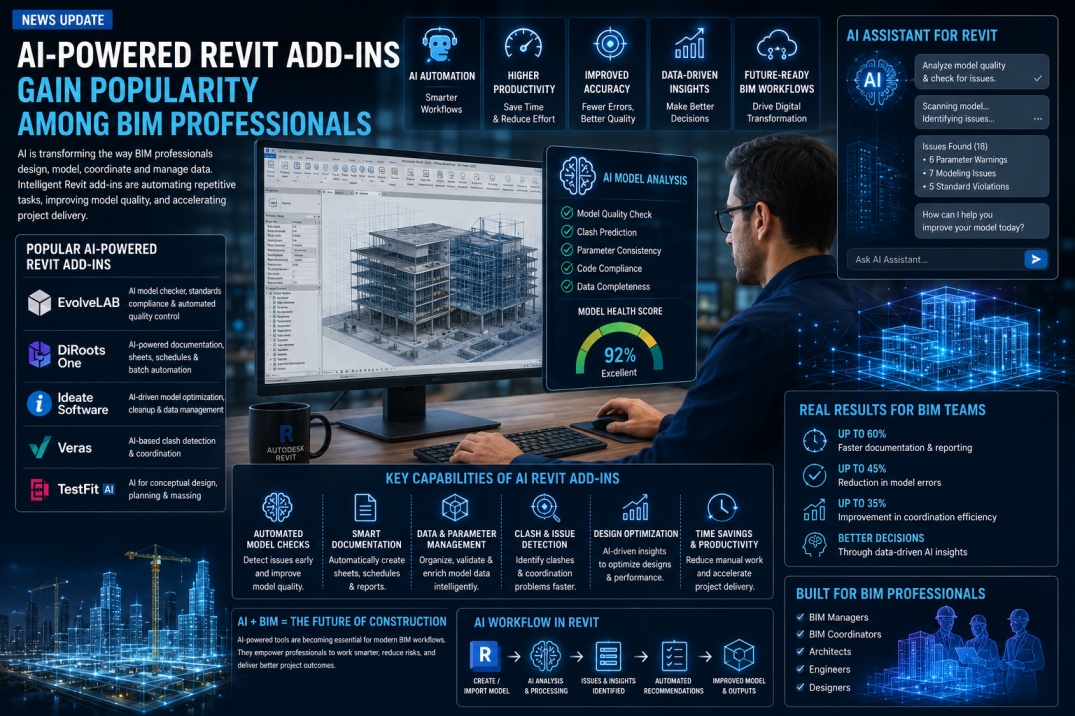
Artificial Intelligence (AI) continues making a significant impact across the Architecture, Engineering, and Construction (AEC) industry, with AI-powered Revit add-ins becoming increasingly popular among BIM professionals.
As project complexity grows and BIM teams face increasing pressure to improve efficiency, many organizations are exploring AI-driven tools that can automate repetitive tasks, enhance model quality, and streamline project workflows.
Industry observers report growing interest in AI-assisted BIM solutions as firms seek ways to reduce manual effort while improving project delivery outcomes.
AI Expands Beyond Traditional BIM Workflows
Building Information Modeling has traditionally relied on manual modeling, coordination, documentation, and data management processes.
While these workflows remain essential, AI technologies are introducing new capabilities that help professionals work more efficiently.
Modern AI-powered Revit add-ins can assist with:
- Model analysis.
- Automated documentation.
- Data management.
- Quality control checks.
- Parameter management.
- Design optimization.
These tools allow BIM teams to focus more on decision-making and coordination rather than repetitive tasks.
Growing Demand for Productivity Improvements
Construction projects generate vast amounts of information throughout design and construction phases.
Managing this information manually can be time-consuming and resource-intensive.
AI-powered Revit tools help address these challenges by automating processes that traditionally require significant effort.
Benefits include:
- Faster modeling workflows.
- Improved data consistency.
- Reduced human error.
- Enhanced project efficiency.
- Better quality assurance.
Automated Model Quality Checks
One of the most promising applications of AI within BIM is automated model validation.
AI systems can review project models and identify potential issues such as:
- Missing information.
- Parameter inconsistencies.
- Modeling errors.
- Standards compliance issues.
- Coordination concerns.
By detecting issues earlier, project teams can improve model quality and reduce downstream risks.
Supporting BIM Coordinators and Managers
AI-powered add-ins are increasingly being used to support BIM Managers and BIM Coordinators.
Rather than replacing professionals, these tools function as intelligent assistants that help teams manage larger and more complex projects.
Common applications include:
- Project auditing.
- Model health analysis.
- Standards verification.
- Data consistency reviews.
- Automated reporting.
These capabilities help improve project governance and coordination processes.
Enhancing Documentation Workflows
Project documentation remains one of the most time-consuming aspects of BIM project delivery.
AI-assisted tools can help accelerate documentation workflows by:
- Generating schedules.
- Organizing project information.
- Automating repetitive documentation tasks.
- Improving data extraction processes.
This allows project teams to spend more time focusing on design and coordination activities.
Integration with Cloud-Based Platforms
Many AI-powered BIM solutions are being integrated with cloud collaboration platforms and Common Data Environments (CDEs).
This integration supports:
- Real-time project insights.
- Automated issue tracking.
- Data-driven decision-making.
- Enhanced project visibility.
Cloud-based AI capabilities are expected to become increasingly important as digital construction workflows continue evolving.
Supporting Digital Construction Transformation
The rise of AI-powered Revit add-ins reflects broader digital transformation trends across the construction industry.
Organizations are increasingly investing in technologies such as:
- Artificial Intelligence.
- Digital Twins.
- Cloud Collaboration.
- Reality Capture.
- Advanced Analytics.
These technologies are helping firms improve efficiency, reduce project risks, and enhance project outcomes.
Skills BIM Professionals Need
As AI adoption increases, BIM professionals are expanding their skill sets beyond traditional modeling workflows.
Important areas of knowledge now include:
- AI-assisted BIM workflows.
- Data management.
- Automation tools.
- Dynamo scripting.
- Cloud collaboration platforms.
- Digital Twin technologies.
Professionals who understand these technologies may be better positioned for future career opportunities.
Industry Outlook
Industry experts expect AI-powered BIM tools to continue evolving rapidly over the next several years.
Future developments may include:
- Intelligent model generation.
- Automated clash resolution suggestions.
- Predictive project analytics.
- AI-driven design optimization.
- Enhanced Digital Twin integration.
These advancements could significantly improve how BIM teams design, coordinate, and manage projects.
Conclusion
AI-powered Revit add-ins are quickly gaining popularity among BIM professionals as organizations seek greater efficiency and smarter project workflows.
By automating repetitive tasks, improving model quality, and providing intelligent project insights, these tools are helping BIM teams work more effectively while supporting broader digital transformation initiatives.
Although human expertise remains essential, AI is becoming an increasingly valuable assistant within the BIM ecosystem. As technology continues advancing, AI-powered tools are expected to play a larger role in the future of digital construction and Building Information Modeling.