Major Infrastructure Projects Increasing BIM and Digital Twin Requirements
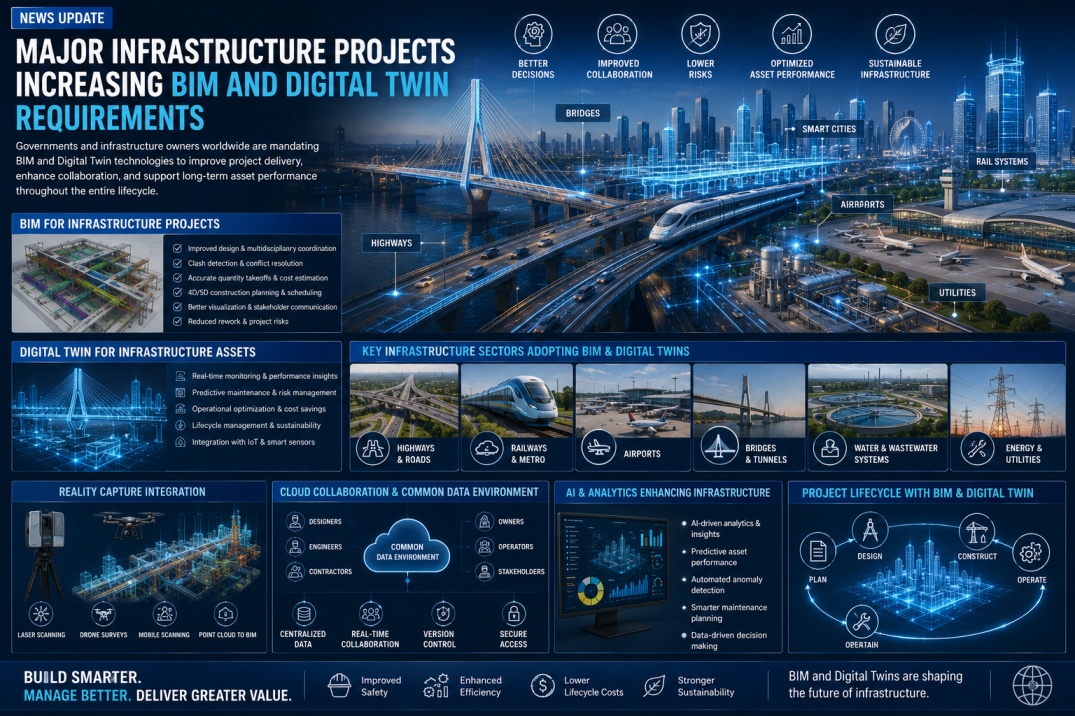
The global infrastructure sector is experiencing a significant digital transformation as project owners increasingly require Building Information Modeling (BIM) and Digital Twin technologies for large-scale infrastructure developments.
From transportation networks and rail corridors to airports, bridges, highways, and utility systems, infrastructure organizations are embracing digital workflows to improve project delivery and long-term asset performance.
Industry experts report that BIM and Digital Twin requirements are becoming more common in project specifications, procurement processes, and government infrastructure programs worldwide.
Growing Digital Transformation in Infrastructure
Infrastructure projects are becoming larger, more complex, and more data-intensive than ever before.
Traditional project management approaches often struggle to manage the vast amount of information generated throughout the design, construction, and operational phases of major assets.
As a result, many owners are adopting BIM and Digital Twin strategies to improve collaboration, information management, and decision-making.
Key drivers include:
- Improved project coordination.
- Enhanced asset management.
- Better lifecycle planning.
- Reduced project risks.
- Increased operational efficiency.
- Support for sustainability goals.
BIM Becomes a Standard Requirement
Many infrastructure agencies now require BIM deliverables throughout project development.
BIM enables project teams to create intelligent digital models containing geometry, asset information, schedules, and documentation that support the entire project lifecycle.
Benefits of BIM for infrastructure projects include:
- Improved multidisciplinary coordination.
- Clash detection and conflict resolution.
- Better design visualization.
- More accurate quantity takeoffs.
- Enhanced construction planning.
- Improved stakeholder communication.
These capabilities help reduce costly rework and improve overall project efficiency.
Digital Twins Move Beyond Buildings
While Digital Twins initially gained popularity within building management applications, adoption is rapidly expanding into infrastructure sectors.
Infrastructure owners are creating Digital Twins of:
- Highways.
- Rail networks.
- Airports.
- Bridges.
- Tunnels.
- Utility systems.
- Ports and logistics hubs.
These virtual environments help operators monitor performance, predict maintenance needs, and optimize asset operations using real-time data.
Transportation Projects Lead Adoption
Transportation infrastructure projects remain among the largest adopters of BIM and Digital Twin technologies.
Rail authorities, airport operators, and highway agencies increasingly require digital project delivery standards to improve long-term asset management.
Digital workflows support:
- Design coordination.
- Construction sequencing.
- Operational planning.
- Maintenance scheduling.
- Safety management.
These benefits contribute to improved infrastructure performance throughout the asset lifecycle.
Supporting Smart Infrastructure Initiatives
The growth of Smart Cities is also accelerating demand for BIM and Digital Twin technologies.
Smart infrastructure relies on connected systems that generate real-time operational data through sensors, IoT devices, and monitoring platforms.
When integrated with BIM models and Digital Twins, this information creates powerful tools for infrastructure management.
Applications include:
- Traffic monitoring.
- Energy optimization.
- Utility management.
- Environmental monitoring.
- Public safety planning.
Role of Cloud Collaboration Platforms
Cloud-based project delivery platforms continue playing a critical role in infrastructure BIM workflows.
Solutions such as Autodesk Construction Cloud and other Common Data Environment (CDE) platforms enable project teams to collaborate more effectively across multiple disciplines and geographic locations.
Benefits include:
- Centralized information management.
- Improved document control.
- Real-time collaboration.
- Enhanced project transparency.
- Better stakeholder engagement.
Cloud collaboration is becoming an essential component of modern infrastructure delivery.
Artificial Intelligence Enhances Asset Management
Artificial Intelligence is increasingly being integrated with BIM and Digital Twin platforms.
AI-powered analytics help infrastructure owners:
- Predict maintenance requirements.
- Analyze asset performance.
- Identify operational risks.
- Optimize resource allocation.
- Improve decision-making.
These capabilities support more proactive infrastructure management strategies.
Sustainability and Lifecycle Performance
Many infrastructure owners are using BIM and Digital Twins to support sustainability objectives and long-term operational efficiency.
Digital technologies help organizations evaluate:
- Energy consumption.
- Carbon emissions.
- Material performance.
- Lifecycle costs.
- Environmental impacts.
This information supports more sustainable infrastructure development and operation.
Industry Outlook
Industry analysts expect BIM and Digital Twin requirements to continue expanding across infrastructure sectors over the coming years.
Future developments may include:
- Real-time Digital Twin monitoring.
- AI-powered asset optimization.
- Autonomous infrastructure inspections.
- Advanced predictive maintenance.
- Enhanced Smart City integration.
These innovations are expected to further strengthen digital project delivery across the infrastructure industry.
Conclusion
Major infrastructure projects worldwide are increasingly requiring BIM and Digital Twin technologies as organizations pursue greater efficiency, improved coordination, and better lifecycle asset management.
As transportation networks, utilities, airports, and Smart City developments continue growing in complexity, digital construction workflows are becoming essential tools for successful project delivery and long-term operational performance.
For BIM professionals, Digital Twin specialists, and infrastructure organizations, this trend represents a significant opportunity to participate in the next generation of connected and intelligent infrastructure development.