How AI is Transforming BIM Workflows in the Construction Industry
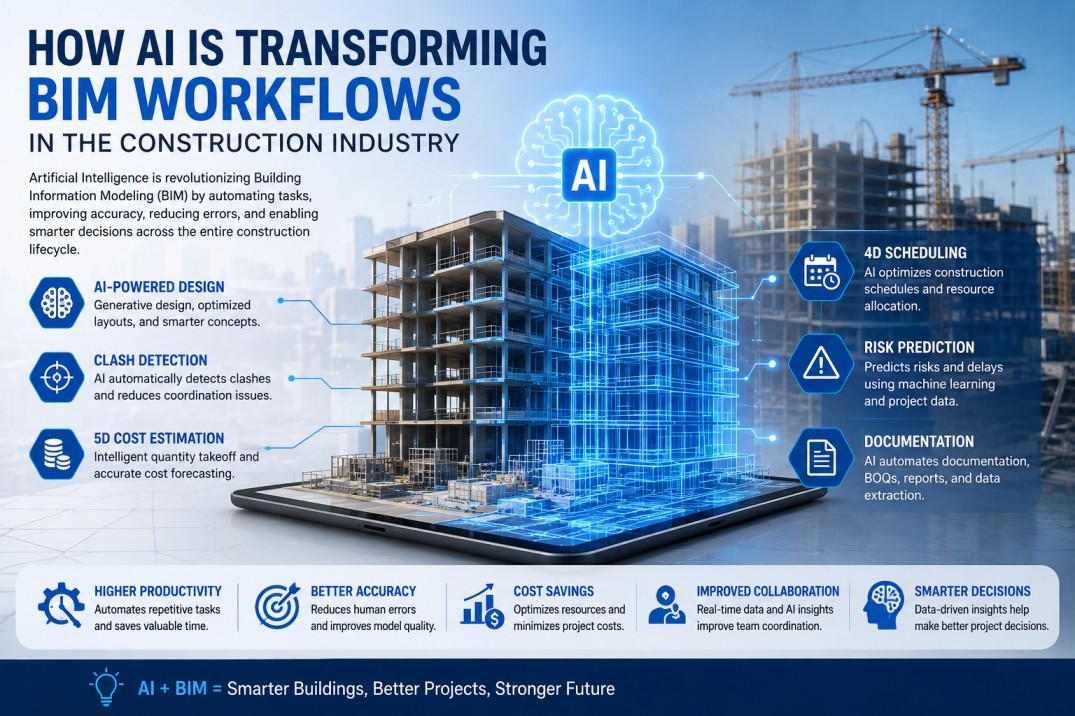
Artificial Intelligence (AI) is rapidly transforming the architecture, engineering, and construction industry by improving Building Information Modeling (BIM) workflows. AI-powered technologies are helping BIM professionals automate repetitive tasks, improve project accuracy, reduce errors, and increase overall productivity.
Today, BIM workflows are becoming smarter through the integration of AI, machine learning, cloud collaboration, and digital construction technologies. These advancements are changing how architects, engineers, contractors, and BIM coordinators manage building projects.
Traditional BIM workflows already improve collaboration and project visualization, but AI takes BIM to another level by enabling predictive analysis, automation, intelligent design optimization, and real-time decision-making.
One of the biggest advantages of AI in BIM is automation. AI tools can automate repetitive modeling tasks, data organization, clash detection, quantity estimation, and documentation workflows.
This automation helps BIM professionals save time and focus more on design quality, project coordination, and construction planning.
Another important benefit of AI-powered BIM workflows is improved clash detection. BIM software integrated with AI can automatically identify conflicts between architectural, structural, plumbing, HVAC, and electrical systems before construction begins.
Early clash detection reduces expensive on-site problems, minimizes delays, and improves coordination between multiple project disciplines.
AI is also improving BIM-based design optimization. Intelligent algorithms can analyze building layouts, structural performance, material usage, and energy efficiency to suggest smarter design solutions.
This helps architects and engineers create more efficient, sustainable, and cost-effective buildings.
Machine learning technology allows BIM systems to learn from previous projects and improve future construction workflows. AI systems can identify patterns, predict risks, and provide recommendations based on project data.
Another major application of AI in BIM is project scheduling and construction planning. AI-powered 4D BIM workflows help contractors optimize construction sequencing, improve resource allocation, and reduce scheduling conflicts.
AI is also transforming 5D BIM cost estimation. Intelligent systems can analyze quantities, labor costs, material prices, and project data to generate more accurate budgeting and cost estimation workflows.
This improves financial planning and reduces the risk of project cost overruns.
Cloud collaboration platforms integrated with AI are making BIM workflows more efficient. Project teams working from different locations can collaborate in real time using centralized BIM models and intelligent project management systems.
AI-powered BIM systems also improve quality control by automatically detecting modeling errors, missing information, duplicate elements, and inconsistent project data.
Another important advancement is the integration of digital twin technology with AI and BIM workflows. Digital twins are virtual representations of real buildings connected with live operational data.
Combining BIM, AI, and digital twins helps facility managers monitor building performance, optimize maintenance, reduce energy consumption, and improve operational efficiency.
AI is also helping improve sustainability analysis within BIM workflows. Intelligent systems can analyze energy performance, daylight optimization, material efficiency, and environmental impact during the design process.
This helps architects and engineers create more sustainable and energy-efficient buildings.
Popular AI Tools Used in BIM Workflows
Many BIM and construction companies are now using AI-powered software tools to improve project coordination, automation, scheduling, clash detection, and digital construction workflows.
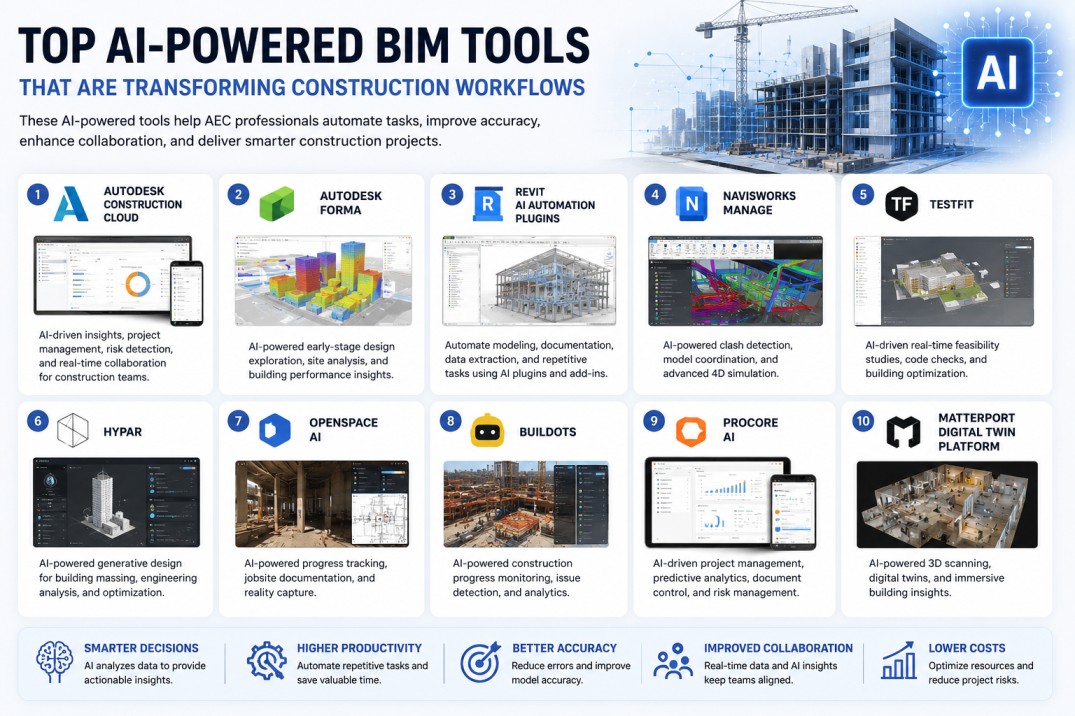
Some of the most widely used AI-powered BIM tools include:
These AI-powered BIM tools help architects, engineers, contractors, and BIM coordinators automate repetitive tasks, optimize layouts, improve clash detection, reduce project risks, and increase overall project efficiency.
AI tools are also improving BIM-based cost estimation, scheduling, sustainability analysis, facility management, and smart building workflows.
Popular BIM software platforms such as Autodesk Revit, Navisworks, Bentley Systems, and ArchiCAD are increasingly integrating AI-powered features and automation technologies.
Construction companies worldwide are investing heavily in AI-powered BIM technologies because they improve productivity, reduce risks, and increase project profitability.
Despite its advantages, AI in BIM still faces challenges such as data management complexity, implementation costs, software integration, and the need for skilled BIM professionals.
However, as AI technology continues to evolve, these challenges are expected to decrease significantly over time.
The future of AI-driven BIM workflows looks extremely promising. Technologies such as generative design, predictive analytics, robotics, augmented reality (AR), virtual reality (VR), and cloud collaboration will continue transforming the construction industry.
As digital construction becomes more advanced, AI and BIM together will play a major role in improving project planning, collaboration, sustainability, and smart building management.
Today, understanding AI-powered BIM workflows is becoming increasingly important for architects, engineers, contractors, BIM modelers, and construction professionals worldwide.
The integration of Artificial Intelligence and BIM is shaping the future of the construction industry by improving efficiency, reducing errors, automating workflows, and enabling smarter project delivery.