What are BIM Dimensions? Complete Guide to 2D, 3D, 4D, 5D, 6D and 7D BIM
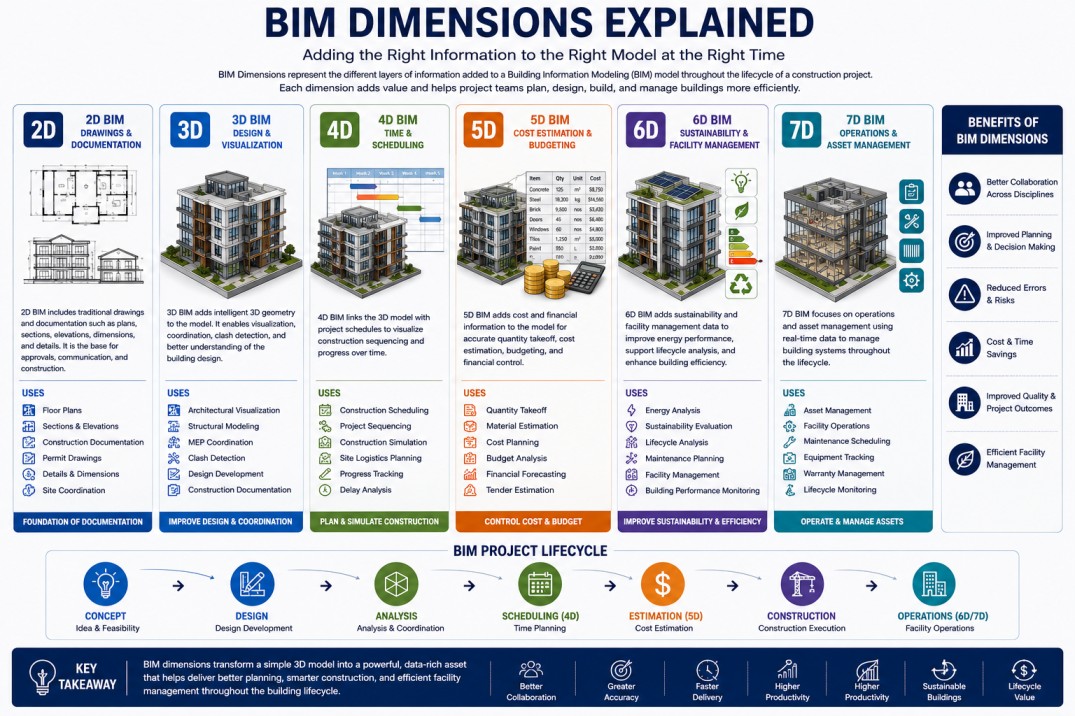
Building Information Modeling (BIM) is revolutionizing the architecture, engineering, and construction industry by improving project visualization, collaboration, coordination, and project management workflows.
One of the most important concepts in BIM workflows is BIM Dimensions. BIM dimensions represent the different layers of information added to a BIM model throughout the lifecycle of a construction project.
Each BIM dimension adds specific data and functionality that helps architects, engineers, contractors, BIM coordinators, and facility managers plan, design, construct, and manage buildings more efficiently.
Traditional construction workflows mainly relied on 2D drawings and documentation. Modern BIM workflows expand this process by integrating intelligent 3D modeling, scheduling, cost estimation, sustainability analysis, and facility management data into a centralized digital model.
The most commonly used BIM dimensions are 2D BIM, 3D BIM, 4D BIM, 5D BIM, 6D BIM, and 7D BIM.
Understanding BIM dimensions helps improve collaboration, reduce project errors, increase productivity, and optimize construction workflows.
2D BIM – Drawings & Documentation
2D BIM represents traditional technical drawings and documentation generated from BIM models. It includes floor plans, sections, elevations, dimensions, annotations, and construction details used for approvals and site execution.
Although BIM is mainly associated with 3D modeling, 2D drawings remain essential for construction documentation and communication between project teams.
2D BIM is commonly used for:
- Floor plans
- Sections and elevations
- Construction documentation
- Permit drawings
- Technical detailing
- Site coordination
2D BIM helps architects, engineers, and contractors communicate technical information clearly during the design and construction process.
3D BIM – Design & Visualization
3D BIM adds intelligent three-dimensional geometry to the BIM model. It allows project teams to create realistic digital building models containing architectural, structural, plumbing, HVAC, and electrical systems.
3D BIM improves project visualization and helps identify design conflicts before construction begins.
3D BIM is commonly used for:
- Architectural visualization
- Structural modeling
- MEP coordination
- Clash detection
- Design development
- Construction documentation
One major advantage of 3D BIM is improved collaboration between architects, engineers, contractors, and project stakeholders.
4D BIM – Time & Scheduling
4D BIM integrates scheduling and time-related information into the BIM model. Construction activities are linked with project timelines to visualize the entire construction sequence before site work begins.
4D BIM helps contractors and project managers improve planning, sequencing, and scheduling workflows.
4D BIM is commonly used for:
- Construction scheduling
- Project sequencing
- Site logistics planning
- Construction simulation
- Progress tracking
- Delay analysis
Using 4D BIM helps reduce scheduling conflicts and improves project coordination during construction.
5D BIM – Cost Estimation & Budgeting
5D BIM adds financial and cost-related information to the BIM model. It allows project teams to perform quantity takeoff, material estimation, budgeting, and cost planning directly from BIM components.
5D BIM improves financial management and helps reduce project cost overruns.
5D BIM is commonly used for:
- Quantity takeoff
- Material estimation
- Cost planning
- Budget analysis
- Financial forecasting
- Tender estimation
One major benefit of 5D BIM is automatic cost updates whenever design changes occur inside the BIM model.
6D BIM – Sustainability & Facility Management
6D BIM focuses on sustainability analysis, energy performance, and facility management data. This BIM dimension helps improve building operation efficiency and long-term maintenance planning.
6D BIM supports sustainable construction and smart building management workflows.
6D BIM is commonly used for:
- Energy analysis
- Sustainability evaluation
- Lifecycle analysis
- Maintenance planning
- Facility management
- Building performance monitoring
Using 6D BIM helps reduce maintenance costs and improve operational efficiency throughout the building lifecycle.
7D BIM – Operations & Asset Management
7D BIM focuses on building operations, asset management, and facility maintenance. This dimension provides detailed operational information about building systems, equipment, warranties, and maintenance schedules.
7D BIM helps facility managers operate buildings more efficiently after construction completion.
7D BIM is commonly used for:
- Asset management
- Facility operations
- Maintenance scheduling
- Equipment tracking
- Lifecycle monitoring
- Warranty management
Modern BIM workflows continue to evolve with technologies such as cloud collaboration, artificial intelligence (AI), digital twins, virtual reality (VR), and augmented reality (AR).
Today, BIM dimensions are becoming increasingly important for architects, engineers, contractors, BIM modelers, project managers, and facility management professionals worldwide.
Understanding BIM dimensions helps improve planning, collaboration, scheduling, budgeting, sustainability, and overall construction project efficiency.
As digital construction technology continues to grow, BIM dimensions will play an even more important role in the future of smart building design and construction management.