BIM Collaboration Best Practices for Large Projects
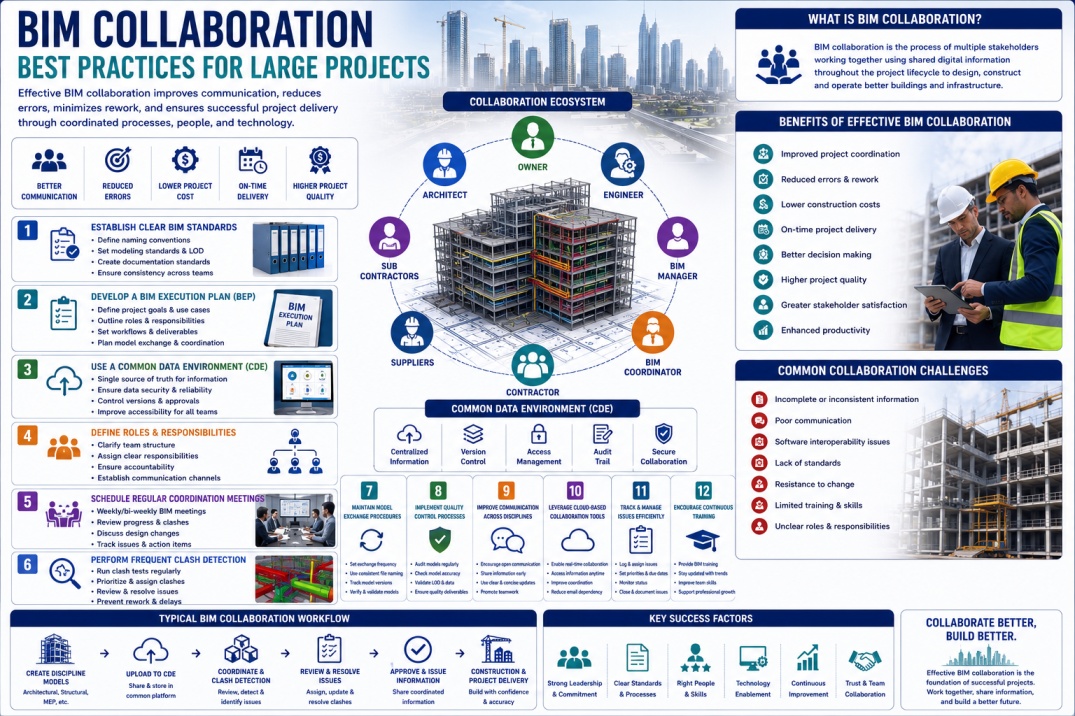
Building Information Modeling (BIM) has fundamentally changed how construction projects are designed, coordinated, and delivered. Unlike traditional workflows where disciplines often work independently, BIM promotes collaboration through shared digital information and coordinated project models.
Large construction projects can involve hundreds of stakeholders, multiple design disciplines, contractors, consultants, suppliers, and owners. Managing communication and project information across such a large team can be challenging without a structured collaboration strategy.
Effective BIM collaboration helps project teams improve communication, reduce conflicts, prevent costly mistakes, and maintain project schedules. Organizations that establish strong collaboration practices are more likely to achieve successful project outcomes.
What is BIM Collaboration?
BIM collaboration refers to the process of multiple project stakeholders working together using shared digital information throughout the lifecycle of a project.
Rather than exchanging disconnected drawings and documents, BIM teams collaborate through coordinated models, cloud platforms, common standards, and structured workflows.
The primary goal is to ensure that all project participants have access to accurate and up-to-date information.
Why Collaboration is Critical in Large Projects
Large projects often involve multiple buildings, complex systems, numerous consultants, and tight schedules.
Without proper collaboration, teams may experience:
- Design conflicts.
- Communication breakdowns.
- Duplicate work.
- Construction delays.
- Cost overruns.
- Information loss.
- Coordination failures.
Strong collaboration practices help eliminate these challenges and improve overall project performance.
1. Establish Clear BIM Standards
One of the first steps in successful BIM collaboration is establishing project standards.
Standards ensure that all team members follow consistent modeling practices and information management procedures.
Standards Should Define
- Naming conventions.
- File organization.
- Modeling requirements.
- Level of Development (LOD).
- Documentation standards.
- Information exchange procedures.
Consistent standards improve project quality and reduce coordination issues.
2. Develop a BIM Execution Plan (BEP)
A BIM Execution Plan (BEP) is one of the most important collaboration documents on a BIM project.
It defines how BIM processes will be implemented and managed throughout the project lifecycle.
Typical BEP Contents
- Project goals.
- Team responsibilities.
- Collaboration workflows.
- Software platforms.
- Coordination procedures.
- Model exchange schedules.
- Quality control requirements.
A well-developed BEP creates alignment among all project stakeholders from the beginning.
3. Use a Common Data Environment (CDE)
A Common Data Environment (CDE) is a centralized platform where project information is stored, managed, and shared.
Examples include:
- Autodesk Construction Cloud.
- BIM 360.
- ProjectWise.
- Aconex.
- SharePoint.
The CDE serves as the single source of truth for project information.
Benefits
- Improved document control.
- Version management.
- Reduced information duplication.
- Better accessibility.
- Enhanced collaboration.
4. Define Roles and Responsibilities
Large BIM projects require clear accountability.
Each stakeholder should understand their responsibilities and deliverables.
Common BIM Roles
- BIM Manager.
- BIM Coordinator.
- BIM Modeler.
- Architect.
- Structural Engineer.
- MEP Engineer.
- Project Manager.
Clearly defined roles reduce confusion and improve workflow efficiency.
5. Schedule Regular Coordination Meetings
Regular BIM coordination meetings are essential for maintaining project alignment.
These meetings provide opportunities to review project progress, discuss issues, and coordinate upcoming activities.
Topics Often Discussed
- Clash detection results.
- Model updates.
- Design changes.
- Project risks.
- Coordination issues.
- Upcoming milestones.
Weekly coordination meetings are common on large BIM projects.
6. Perform Frequent Clash Detection
Clash detection is one of the most valuable BIM collaboration activities.
Tools such as Navisworks help project teams identify conflicts between disciplines before construction begins.
Benefits
- Reduced rework.
- Improved coordination.
- Fewer construction delays.
- Lower project costs.
- Better project quality.
Clash detection should be performed regularly throughout design development.
7. Maintain Consistent Model Exchange Procedures
Project teams must establish clear rules for sharing and updating models.
Without consistent exchange procedures, stakeholders may work with outdated information.
Best Practices
- Define exchange schedules.
- Use consistent file naming.
- Track model versions.
- Document changes.
- Verify uploads.
Reliable information exchange improves project coordination and reduces errors.
8. Implement Quality Control Processes
Quality control is essential for maintaining reliable BIM information.
Project teams should establish model review procedures to ensure compliance with project standards.
Quality Checks May Include
- Model audits.
- Warning reviews.
- LOD verification.
- Parameter validation.
- Documentation reviews.
Regular quality control reduces the risk of coordination problems later in the project.
9. Improve Communication Across Disciplines
Technology alone cannot guarantee successful collaboration.
Strong communication between project teams remains essential.
Organizations should encourage:
- Open communication.
- Issue tracking.
- Knowledge sharing.
- Cross-disciplinary discussions.
- Timely feedback.
Effective communication helps prevent misunderstandings and improves project performance.
10. Leverage Cloud-Based Collaboration Tools
Cloud technologies have significantly improved BIM collaboration capabilities.
Platforms such as Autodesk Construction Cloud enable teams to collaborate from multiple locations while maintaining access to centralized project information.
Benefits
- Remote collaboration.
- Real-time updates.
- Improved accessibility.
- Enhanced issue management.
- Better document control.
Cloud platforms have become increasingly important for global and distributed project teams.
11. Track and Manage Issues Efficiently
Large projects generate numerous design and coordination issues.
A structured issue management process helps teams track, assign, and resolve problems efficiently.
Issue Tracking Should Include
- Issue description.
- Responsible party.
- Priority level.
- Due date.
- Resolution status.
Well-managed issues contribute to smoother project delivery.
12. Encourage Continuous Training
BIM technology continues evolving rapidly.
Organizations should invest in ongoing training to ensure project teams remain current with industry standards and software developments.
Training Areas
- Revit workflows.
- Navisworks coordination.
- ISO 19650 standards.
- Cloud collaboration platforms.
- Digital Twin technologies.
Continuous learning supports long-term project success.
Common Collaboration Challenges
Even well-managed projects may encounter collaboration challenges.
- Incomplete information.
- Software interoperability issues.
- Poor communication.
- Inconsistent standards.
- Resistance to change.
- Limited training.
Recognizing these challenges early allows project teams to develop proactive solutions.
Benefits of Effective BIM Collaboration
Organizations that implement strong collaboration practices often experience measurable improvements.
- Improved project quality.
- Reduced rework.
- Faster decision-making.
- Better stakeholder satisfaction.
- Reduced project risks.
- Improved schedule performance.
- Lower construction costs.
- Enhanced productivity.
These benefits make BIM collaboration a strategic advantage for modern construction projects.
The Future of BIM Collaboration
The future of BIM collaboration will be shaped by cloud technologies, Artificial Intelligence, Digital Twins, automation, and advanced analytics.
Emerging technologies will enable:
- Real-time project monitoring.
- AI-powered coordination.
- Automated issue detection.
- Enhanced Digital Twin integration.
- Smarter project decision-making.
Organizations that embrace collaborative digital workflows will be better positioned to succeed in the future construction industry.
Conclusion
Successful BIM collaboration is essential for large and complex projects. By establishing clear standards, developing a BIM Execution Plan, using a Common Data Environment, performing regular clash detection, and maintaining effective communication, project teams can significantly improve coordination and project outcomes.
Collaboration is not simply a technology issue—it is a combination of people, processes, and digital tools working together toward common project goals.
As BIM adoption continues expanding worldwide, organizations that invest in strong collaboration practices will gain significant advantages in project quality, efficiency, and overall project success.