BIM for Smart Cities: The Future of Urban Development
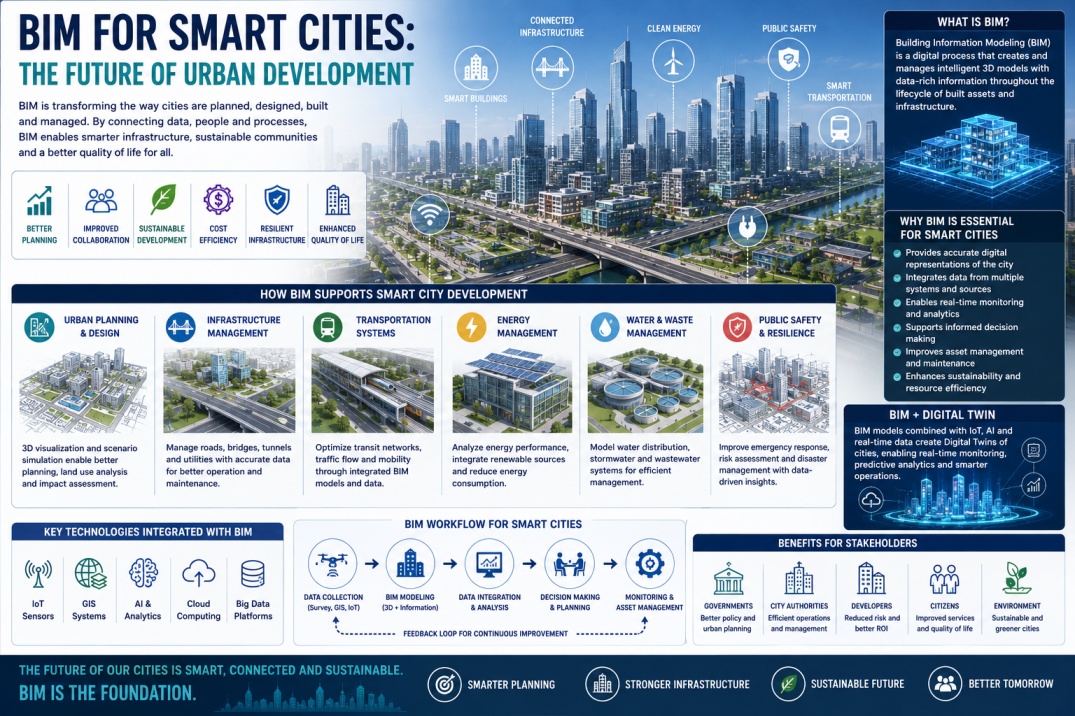
Cities around the world are facing unprecedented challenges. Rapid urbanization, population growth, aging infrastructure, environmental concerns, and increasing demands for public services require new approaches to planning and development. Traditional urban planning methods often struggle to manage the complexity of modern cities efficiently.
To address these challenges, governments and organizations are investing heavily in Smart City technologies. These technologies leverage digital data, automation, connectivity, and advanced analytics to improve urban infrastructure, public services, and quality of life.
One of the most important technologies supporting Smart City initiatives is Building Information Modeling (BIM). Originally developed for building design and construction, BIM has evolved into a powerful platform for managing infrastructure and supporting intelligent urban development.
What is a Smart City?
A Smart City uses digital technologies, data analytics, sensors, communication networks, and intelligent infrastructure to improve city operations and enhance the quality of life for citizens.
Smart Cities focus on optimizing:
- Transportation systems.
- Energy consumption.
- Water management.
- Public safety.
- Waste management.
- Infrastructure maintenance.
- Environmental sustainability.
- Urban planning.
The goal is to create cities that are more efficient, sustainable, resilient, and livable.
What is BIM?
Building Information Modeling (BIM) is a process used to create and manage digital representations of physical and functional assets.
BIM models contain intelligent information about buildings and infrastructure, including geometry, materials, specifications, schedules, maintenance data, and operational information.
Unlike traditional drawings, BIM provides a data-rich environment that supports collaboration and informed decision-making throughout the lifecycle of an asset.
Why BIM Matters for Smart Cities
Smart Cities depend on accurate, accessible, and connected information. BIM provides the digital foundation required to manage complex urban environments.
Through BIM, city planners and stakeholders can visualize, analyze, and manage urban assets more effectively.
BIM supports:
- Better planning decisions.
- Improved infrastructure management.
- Enhanced collaboration.
- Data integration.
- Lifecycle asset management.
- Digital Twin development.
These capabilities make BIM a key component of Smart City ecosystems.
BIM and Urban Planning
Urban planning requires coordination between numerous stakeholders, including architects, engineers, government agencies, utility providers, transportation authorities, and developers.
BIM enables planners to create detailed digital representations of buildings, roads, bridges, utilities, and public spaces before construction begins.
Benefits include:
- Improved visualization.
- Better stakeholder communication.
- Enhanced design evaluation.
- Reduced planning conflicts.
- More informed decision-making.
By visualizing entire neighborhoods and districts digitally, planners can evaluate potential impacts before implementing projects.
Infrastructure Management with BIM
Modern cities depend on extensive infrastructure networks, including roads, railways, airports, utilities, water systems, and public facilities.
Managing these assets efficiently is critical for long-term sustainability.
BIM helps organizations:
- Track asset information.
- Monitor infrastructure conditions.
- Plan maintenance activities.
- Manage renovations.
- Support asset lifecycle management.
Having accurate digital asset information improves operational efficiency and reduces maintenance costs.
BIM and Digital Twins
One of the most exciting developments in Smart Cities is the integration of BIM with Digital Twin technology.
A Digital Twin is a virtual representation of a physical asset connected to real-time operational data.
BIM models often serve as the foundation for creating Digital Twins.
When combined with sensors, IoT devices, and analytics platforms, BIM models can evolve into living digital representations of entire buildings, infrastructure networks, and even cities.
This enables real-time monitoring and more effective urban management.
Transportation Planning and BIM
Transportation is a major component of Smart City development.
BIM supports transportation projects by providing accurate digital models of:
- Road networks.
- Rail systems.
- Airports.
- Bridges.
- Tunnels.
- Transit stations.
Digital models help planners evaluate traffic patterns, optimize infrastructure design, and improve transportation efficiency.
Better transportation planning contributes to reduced congestion and improved mobility.
Energy Efficiency and Sustainability
Sustainability is one of the primary goals of Smart Cities.
BIM supports sustainability by enabling:
- Energy analysis.
- Building performance simulations.
- Carbon reduction strategies.
- Renewable energy integration.
- Resource optimization.
By analyzing building and infrastructure performance before construction, organizations can reduce environmental impacts and improve energy efficiency.
Water Management and Utilities
Efficient water management is essential for growing urban populations.
BIM helps city planners and utility providers model:
- Water distribution systems.
- Stormwater networks.
- Sewer infrastructure.
- Treatment facilities.
- Utility corridors.
These digital models support maintenance planning, capacity analysis, and infrastructure upgrades.
Improved Collaboration Across Stakeholders
Smart City projects involve numerous organizations working together.
BIM provides a collaborative environment where stakeholders can access consistent project information and coordinate activities more effectively.
Benefits include:
- Improved communication.
- Reduced conflicts.
- Better information sharing.
- Enhanced project coordination.
- Faster decision-making.
Cloud platforms such as Autodesk Construction Cloud further enhance collaboration by providing centralized information management.
Role of IoT in Smart Cities
The Internet of Things (IoT) plays a critical role in Smart City operations.
Sensors embedded throughout infrastructure generate data related to:
- Traffic conditions.
- Energy usage.
- Air quality.
- Water consumption.
- Equipment performance.
- Public safety systems.
When connected to BIM and Digital Twin platforms, this information helps city managers monitor performance and optimize operations.
Challenges of BIM Implementation in Smart Cities
Although BIM offers significant benefits, implementing BIM at a city-wide scale can present challenges.
Common challenges include:
- Large data volumes.
- Interoperability requirements.
- Training needs.
- Technology investments.
- Information security concerns.
- Data management complexity.
Successful implementation requires strong leadership, standards, and collaboration among stakeholders.
Examples of BIM in Smart City Projects
Many cities around the world are already using BIM to support Smart City initiatives.
Applications include:
- Airport expansions.
- Railway infrastructure.
- Urban redevelopment projects.
- Smart utility networks.
- Digital city models.
- Large-scale transportation systems.
These projects demonstrate how BIM can improve planning, construction, and long-term asset management.
Future of BIM in Smart Cities
The future of Smart Cities will rely heavily on data integration, Digital Twins, Artificial Intelligence, and cloud-based collaboration.
BIM will continue evolving from a project delivery tool into a comprehensive platform supporting city-wide information management.
Emerging technologies are expected to enable:
- AI-powered urban analytics.
- Predictive infrastructure maintenance.
- Advanced Digital Twin platforms.
- Real-time city monitoring.
- Autonomous infrastructure management.
These developments will help create smarter, more efficient urban environments.
Career Opportunities in Smart City BIM
As Smart City initiatives expand, demand for BIM professionals is increasing.
Emerging roles include:
- BIM Manager.
- Digital Twin Specialist.
- Smart City Planner.
- Infrastructure BIM Coordinator.
- Asset Information Manager.
- Digital Construction Consultant.
Professionals with BIM and Smart City knowledge will be well-positioned for future career opportunities.
Conclusion
Building Information Modeling is becoming a foundational technology for Smart City development. By providing accurate digital information, supporting collaboration, enabling Digital Twins, and improving infrastructure management, BIM helps cities become more efficient, sustainable, and resilient.
As urban populations continue growing and cities face increasing challenges, BIM will play an essential role in supporting intelligent planning and long-term asset management.
For BIM professionals, understanding Smart City concepts represents an exciting opportunity to participate in the future of digital urban development and next-generation infrastructure management.