BIM Standards Explained: ISO 19650 for Beginners
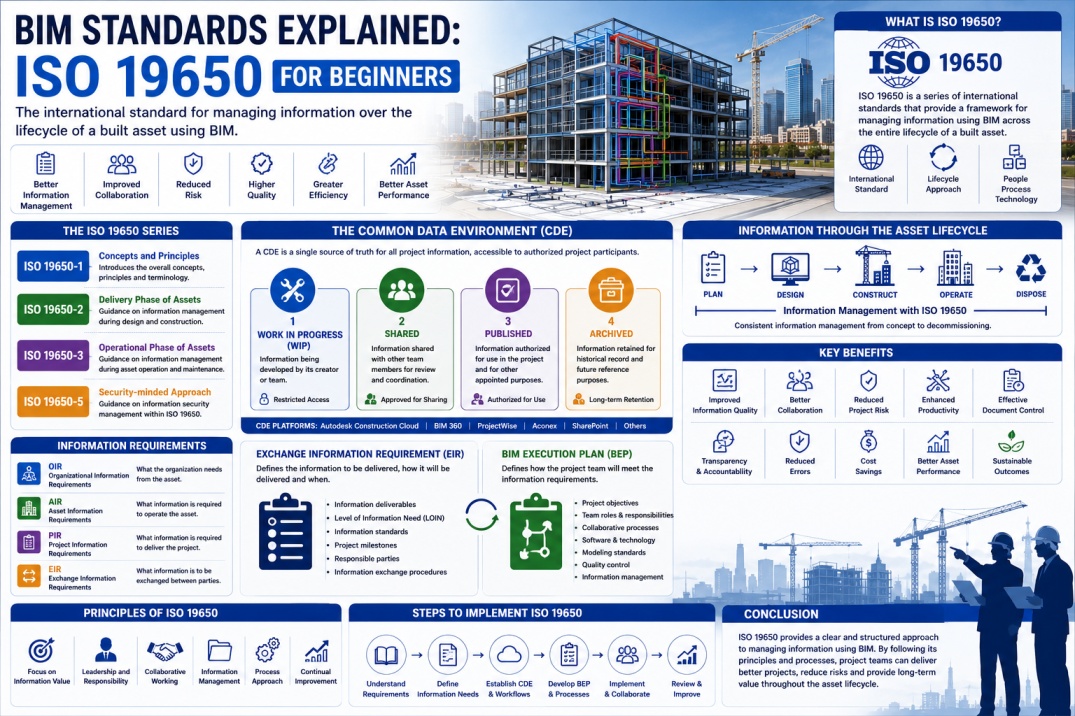
As Building Information Modeling (BIM) continues to transform the Architecture, Engineering, and Construction (AEC) industry, the importance of managing project information effectively has become greater than ever. Modern construction projects involve large amounts of data, multiple stakeholders, and complex collaboration requirements.
Without clear standards and processes, project teams can struggle with document control, version management, communication issues, and information loss. To address these challenges, the international BIM community developed ISO 19650, a globally recognized standard for information management using BIM.
Today, ISO 19650 is becoming the preferred framework for BIM projects across many countries and industries. Understanding its principles is essential for BIM Modelers, BIM Coordinators, BIM Managers, Architects, Engineers, Contractors, and Project Owners.
What is ISO 19650?
ISO 19650 is an international standard that provides guidance for managing information throughout the entire lifecycle of a built asset using BIM processes.
The standard establishes a structured approach for creating, organizing, sharing, approving, and maintaining project information. It helps ensure that the right people have access to the right information at the right time.
Rather than focusing on software tools, ISO 19650 focuses on information management processes that support collaboration and project delivery.
Why Was ISO 19650 Created?
Before ISO 19650, many organizations used different standards and information management practices. This often resulted in inconsistencies between projects, confusion among stakeholders, and inefficient workflows.
The standard was developed to create a common framework that could be used internationally regardless of project size, location, or software platform.
Its primary objectives include:
- Improving information management.
- Supporting BIM collaboration.
- Reducing project risks.
- Improving data quality.
- Enhancing project efficiency.
- Promoting consistent workflows.
The Relationship Between BIM and ISO 19650
Many beginners assume that BIM and ISO 19650 are the same thing, but they serve different purposes.
BIM is a process used to create and manage digital building information, while ISO 19650 provides the framework for managing that information effectively.
Think of BIM as the technology and workflow, while ISO 19650 provides the rules and structure that guide how information should be managed.
Key Parts of ISO 19650
ISO 19650 consists of multiple sections that address different aspects of information management.
ISO 19650-1
This section introduces the concepts and principles of information management using BIM.
It defines the overall framework and explains how project information should be managed throughout an asset's lifecycle.
ISO 19650-2
This part focuses on the delivery phase of assets, including design and construction activities.
It provides guidance on information exchange, project collaboration, and information requirements.
ISO 19650-3
This section addresses asset operation and facility management after project completion.
It ensures information remains valuable throughout the operational life of the asset.
ISO 19650-5
This part focuses on security-minded information management and protecting sensitive project information.
What is a Common Data Environment (CDE)?
One of the most important concepts within ISO 19650 is the Common Data Environment (CDE).
A CDE is a centralized location where project information is stored, managed, and shared.
Examples include:
- Autodesk Construction Cloud.
- BIM 360.
- ProjectWise.
- Aconex.
- SharePoint-based systems.
The CDE serves as the single source of truth for project information, reducing duplication and improving collaboration.
The Four States of Information in a CDE
ISO 19650 defines four information states within a Common Data Environment.
Work in Progress (WIP)
This area contains information currently being developed by project teams.
Access is generally limited to the responsible discipline.
Shared
Once information has been reviewed internally, it is shared with other project stakeholders for coordination purposes.
Published
Published information has been approved and authorized for project use.
This information may be used for construction, procurement, or project delivery activities.
Archived
Archived information is retained for future reference and historical record purposes.
Information Requirements in ISO 19650
A major focus of ISO 19650 is defining information requirements before project work begins.
Common information requirements include:
- Organizational Information Requirements (OIR).
- Asset Information Requirements (AIR).
- Project Information Requirements (PIR).
- Exchange Information Requirements (EIR).
These requirements help ensure project teams understand what information must be delivered and when.
What is an Exchange Information Requirement (EIR)?
The Exchange Information Requirement (EIR) is one of the most important documents in ISO 19650 workflows.
The EIR defines:
- Information deliverables.
- BIM requirements.
- Data standards.
- Project milestones.
- Information exchange procedures.
It helps align project expectations before design and construction activities begin.
BIM Execution Plan (BEP) and ISO 19650
The BIM Execution Plan (BEP) plays a critical role in implementing ISO 19650.
The BEP explains how project teams will meet information requirements and manage BIM processes.
A typical BEP includes:
- Project goals.
- Team responsibilities.
- Software platforms.
- Collaboration workflows.
- Modeling standards.
- Quality control procedures.
The BEP serves as a roadmap for project information management.
Benefits of ISO 19650
Organizations implementing ISO 19650 often experience significant improvements in project delivery and collaboration.
Key benefits include:
- Improved information quality.
- Better project coordination.
- Reduced information loss.
- Enhanced collaboration.
- Improved document control.
- Reduced project risks.
- Greater transparency.
- More efficient workflows.
- Improved asset management.
- International consistency.
Who Should Learn ISO 19650?
ISO 19650 is valuable for many professionals across the AEC industry.
- BIM Modelers.
- BIM Coordinators.
- BIM Managers.
- Architects.
- Structural Engineers.
- MEP Engineers.
- Project Managers.
- Contractors.
- Owners and Facility Managers.
As BIM adoption continues to grow, knowledge of ISO 19650 is becoming increasingly important for career development.
Challenges of ISO 19650 Implementation
Although ISO 19650 provides many benefits, implementation can present challenges.
- Training requirements.
- Process changes.
- Organizational resistance.
- Initial setup effort.
- Documentation requirements.
Successful implementation requires commitment, leadership support, and proper training.
Future of ISO 19650
As digital construction continues evolving, ISO 19650 is expected to become even more important.
Emerging technologies such as Artificial Intelligence, Digital Twins, cloud collaboration, and advanced analytics will increasingly rely on structured information management processes.
Organizations that adopt ISO 19650 today are better positioned to take advantage of future BIM innovations.
Conclusion
ISO 19650 has become the global standard for BIM information management. By providing a structured framework for organizing, sharing, and maintaining project information, it helps project teams improve collaboration, reduce risks, and deliver better project outcomes.
Although the standard may initially seem complex, understanding its core principles is essential for anyone involved in BIM projects. Concepts such as Common Data Environments, Information Requirements, Exchange Information Requirements, and BIM Execution Plans form the foundation of effective BIM information management.
As the construction industry continues moving toward digital project delivery, ISO 19650 will remain a critical standard supporting efficient collaboration and successful BIM implementation worldwide.