How BIM Reduces Construction Costs and Project Delays
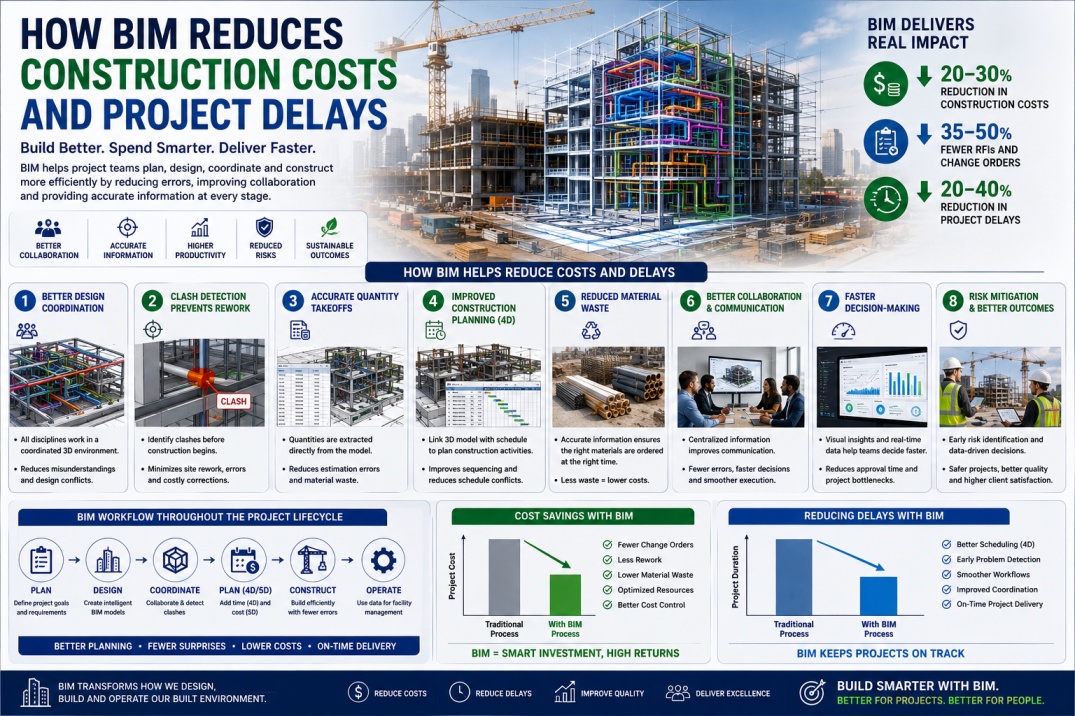
Construction projects are becoming increasingly complex, involving multiple stakeholders, tight schedules, budget constraints, and demanding client expectations. Traditionally, many projects faced challenges such as design conflicts, inaccurate estimates, communication gaps, construction errors, and schedule overruns. These issues often resulted in increased costs and delayed project completion.
Building Information Modeling (BIM) has emerged as one of the most effective solutions for addressing these challenges. By creating intelligent digital models and improving collaboration among project teams, BIM helps reduce risks throughout the project lifecycle.
Today, BIM is widely recognized as a valuable technology that enables better planning, coordination, decision-making, and project execution. Organizations around the world are using BIM to improve productivity, control costs, and deliver projects more efficiently.
What is BIM?
Building Information Modeling (BIM) is a digital process that allows architects, engineers, contractors, and owners to create and manage detailed building information throughout a project's lifecycle.
Unlike traditional 2D drafting, BIM provides intelligent 3D models containing geometry, specifications, quantities, schedules, and project data. This information helps project teams collaborate more effectively and make informed decisions.
Because BIM serves as a centralized source of project information, it improves transparency and reduces misunderstandings between disciplines.
Why Construction Costs Increase
Before understanding how BIM reduces costs, it is important to understand the common reasons construction costs increase.
- Design conflicts and coordination issues.
- Construction rework.
- Material wastage.
- Poor communication.
- Inaccurate quantity estimates.
- Project schedule delays.
- Unexpected site conditions.
- Inefficient resource planning.
Many of these problems can be minimized or eliminated through effective BIM implementation.
Improved Design Coordination
One of BIM's greatest advantages is its ability to improve coordination between project disciplines.
Architectural, structural, mechanical, electrical, plumbing, and fire protection systems can all be integrated into a single coordinated environment.
Instead of working independently, project teams can review how systems interact and identify conflicts before construction begins.
Better coordination leads to fewer surprises during construction and reduces costly modifications in the field.
Clash Detection Prevents Rework
Construction rework is one of the biggest causes of cost overruns and project delays.
BIM enables project teams to perform Clash Detection using software such as Autodesk Navisworks. This process identifies conflicts between building systems before installation.
Examples include:
- HVAC ducts colliding with structural beams.
- Pipes passing through walls.
- Cable trays conflicting with equipment.
- Mechanical systems interfering with ceilings.
Resolving these issues digitally is significantly less expensive than correcting them on-site after construction has begun.
More Accurate Quantity Takeoffs
Estimating material quantities accurately is critical for project budgeting.
Traditional quantity takeoffs often rely on manual calculations, which can introduce errors and inconsistencies.
BIM models contain detailed information about building elements, allowing project teams to generate accurate quantity schedules directly from the model.
Benefits include:
- Reduced estimation errors.
- Improved budget planning.
- Better procurement decisions.
- Reduced material waste.
Accurate quantities help organizations manage costs more effectively throughout construction.
Enhanced Construction Planning
BIM supports advanced planning through 4D scheduling, which combines 3D models with project timelines.
Project teams can visualize construction sequences and identify scheduling conflicts before work begins.
This allows contractors to:
- Optimize construction activities.
- Improve site logistics.
- Reduce downtime.
- Improve workforce utilization.
- Enhance project coordination.
Better planning often leads to faster project delivery and fewer schedule disruptions.
Reduced Material Waste
Material waste can significantly increase construction costs.
BIM provides accurate quantities and detailed project information, helping contractors order the right materials at the right time.
By reducing over-ordering and minimizing mistakes, BIM contributes to more sustainable and cost-effective construction practices.
This not only reduces expenses but also supports environmental goals.
Improved Communication and Collaboration
Construction projects involve many stakeholders, including architects, engineers, contractors, consultants, suppliers, and owners.
Poor communication often leads to misunderstandings, errors, and delays.
BIM provides a shared platform where project teams can access consistent information and collaborate more effectively.
Cloud-based solutions such as Autodesk Construction Cloud further enhance communication by enabling real-time collaboration across multiple locations.
Faster Decision-Making
Decision-making delays can have a major impact on project schedules.
Because BIM provides visual models and centralized project data, stakeholders can quickly evaluate alternatives and make informed decisions.
Improved visibility helps project teams:
- Review design changes.
- Evaluate construction options.
- Assess project impacts.
- Approve modifications faster.
Faster decisions contribute directly to shorter project timelines.
Better Risk Management
Every construction project involves risk.
BIM helps identify potential problems early by providing detailed project visualization and coordination capabilities.
Common risks that BIM helps mitigate include:
- Design conflicts.
- Construction sequencing issues.
- Site logistics challenges.
- Quantity inaccuracies.
- Coordination problems.
Early risk identification allows project teams to develop solutions before issues affect project performance.
Support for Prefabrication and Modular Construction
Prefabrication and modular construction are becoming increasingly popular because they improve efficiency and reduce construction time.
BIM provides the accurate information required to manufacture building components off-site.
Benefits include:
- Improved quality control.
- Reduced site labor.
- Shorter construction schedules.
- Lower installation costs.
- Improved safety.
Accurate BIM models help ensure prefabricated components fit correctly during installation.
Facility Management Benefits
The value of BIM extends beyond construction completion.
Building owners can use BIM information to support facility management, maintenance planning, and operational decision-making.
Having accurate asset information available after project handover reduces future maintenance costs and improves building performance.
How BIM Reduces Project Delays
Project delays often result from poor planning, communication failures, design changes, and unexpected construction issues.
BIM helps reduce delays by:
- Improving project coordination.
- Detecting clashes early.
- Supporting construction planning.
- Enhancing communication.
- Improving decision-making.
- Reducing rework.
- Providing accurate project information.
By addressing these common causes of delays, BIM helps projects stay on schedule and meet delivery milestones.
Real-World Impact of BIM
Many organizations have reported measurable benefits after implementing BIM workflows.
Common outcomes include:
- Reduced change orders.
- Lower project costs.
- Improved productivity.
- Better project quality.
- Shorter construction schedules.
- Enhanced stakeholder satisfaction.
These benefits continue to drive BIM adoption across the global construction industry.
Future of BIM in Cost and Schedule Management
Emerging technologies such as Artificial Intelligence, Digital Twins, cloud collaboration, and advanced analytics are further enhancing BIM capabilities.
Future BIM workflows are expected to provide:
- Predictive project analytics.
- Automated risk assessment.
- AI-powered scheduling.
- Real-time project monitoring.
- Advanced cost forecasting.
These innovations will help organizations achieve even greater improvements in project performance.
Conclusion
Building Information Modeling has become one of the most valuable technologies for reducing construction costs and project delays. Through improved coordination, clash detection, accurate quantity takeoffs, enhanced planning, and better collaboration, BIM helps project teams deliver successful outcomes more efficiently.
As construction projects continue growing in complexity, organizations that embrace BIM gain significant advantages in cost control, schedule management, and overall project quality.
For architects, engineers, contractors, BIM professionals, and project owners, investing in BIM is no longer simply a technological upgrade—it is a strategic decision that supports smarter, faster, and more cost-effective project delivery.