Digital Twin vs BIM: Understanding the Key Differences
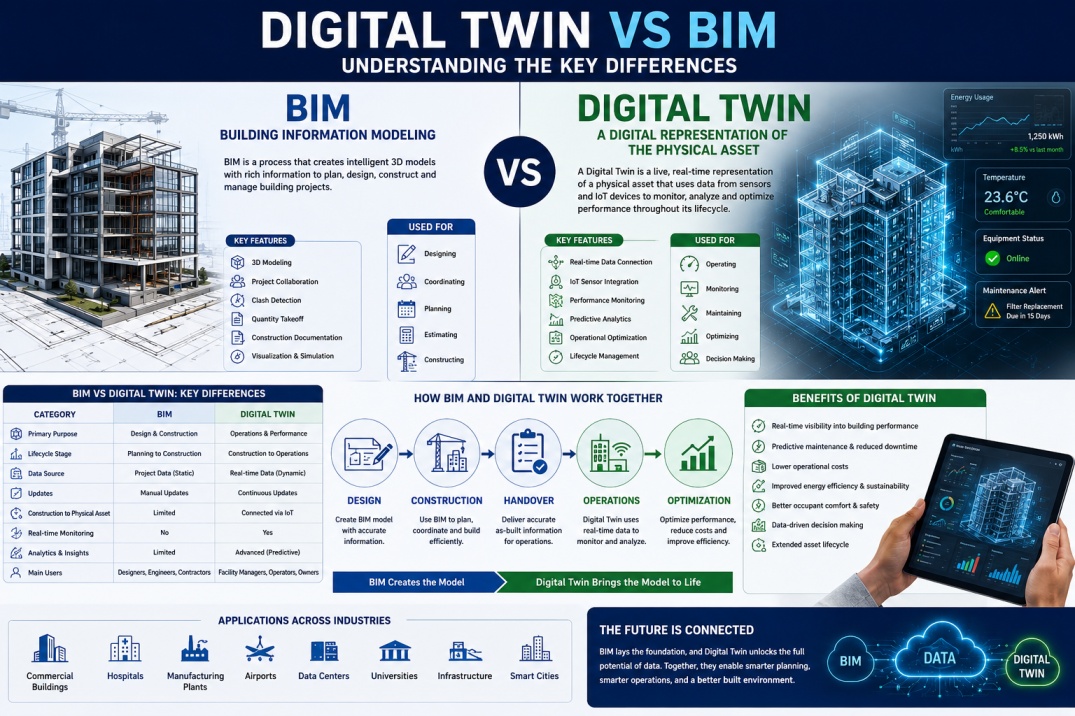
The Architecture, Engineering, and Construction (AEC) industry is undergoing a major digital transformation. Technologies such as Building Information Modeling (BIM), Artificial Intelligence (AI), cloud collaboration, reality capture, and Digital Twins are changing how buildings are designed, constructed, and operated.
Among these innovations, BIM and Digital Twins are often mentioned together. Many professionals assume they are the same technology, but they actually serve different purposes. While BIM focuses on creating and managing project information during design and construction, Digital Twins extend this concept by connecting digital models with real-time operational data.
Understanding the differences between BIM and Digital Twins is becoming increasingly important for architects, engineers, contractors, facility managers, and BIM professionals as the industry moves toward smarter and more connected buildings.
What is BIM?
Building Information Modeling (BIM) is a process used to create and manage digital representations of physical and functional building characteristics. BIM models contain intelligent information about building elements such as walls, floors, roofs, doors, windows, structural components, and MEP systems.
Unlike traditional CAD drawings, BIM models are data-rich and support collaboration between multiple disciplines throughout the design and construction phases of a project.
BIM is commonly used for:
- Architectural design.
- Structural modeling.
- MEP coordination.
- Clash detection.
- Construction documentation.
- Quantity takeoffs.
- Project visualization.
- Construction planning.
Today, software such as Autodesk Revit, Navisworks, Archicad, and Tekla Structures are widely used to develop BIM models.
What is a Digital Twin?
A Digital Twin is a virtual representation of a physical asset that remains connected to the real-world asset through live data and continuous updates.
Unlike a BIM model, which is typically created during design and construction, a Digital Twin continues to evolve throughout the building's operational lifecycle.
Digital Twins integrate data from sensors, IoT devices, building management systems, energy monitoring platforms, and operational databases.
This allows facility owners and operators to monitor building performance in real time and make informed decisions based on current conditions.
Why the Confusion Exists
Both BIM and Digital Twins involve digital representations of physical assets, which often leads to confusion. In many cases, a BIM model serves as the foundation for creating a Digital Twin.
However, the key difference is that BIM primarily focuses on design and construction information, while Digital Twins focus on real-time building operation and performance.
Think of BIM as the digital blueprint of a building and the Digital Twin as the living digital version of that building after it becomes operational.
How BIM Works
During project development, architects, engineers, and BIM professionals create intelligent BIM models that contain geometry, specifications, schedules, quantities, and construction information.
Project teams use these models to:
- Coordinate disciplines.
- Perform clash detection.
- Generate drawings.
- Produce schedules.
- Improve project communication.
- Reduce construction risks.
The BIM model becomes a centralized source of project information throughout design and construction.
How Digital Twins Work
Digital Twins go beyond static project information by connecting the digital model to real-world operational data.
Sensors installed throughout a building continuously collect information such as:
- Temperature.
- Humidity.
- Energy consumption.
- Equipment performance.
- Occupancy levels.
- Air quality.
- Maintenance status.
This information flows into the Digital Twin platform, allowing facility managers to monitor building performance and optimize operations.
Key Differences Between BIM and Digital Twins
| Category | BIM | Digital Twin |
|---|---|---|
| Primary Purpose | Design and Construction | Operations and Maintenance |
| Data Source | Project Information | Real-Time Data |
| Lifecycle Stage | Planning to Construction | Construction to Operations |
| Updates | Manual Updates | Continuous Updates |
| IoT Integration | Limited | Extensive |
| Facility Management | Supportive | Core Function |
| Predictive Analytics | Limited | Advanced |
| Real-Time Monitoring | No | Yes |
Benefits of BIM
BIM has transformed project delivery by improving collaboration and reducing construction risks.
Major BIM benefits include:
- Improved project coordination.
- Reduced design conflicts.
- Enhanced visualization.
- Better documentation.
- More accurate quantity takeoffs.
- Improved project planning.
- Faster decision making.
- Reduced construction costs.
These advantages make BIM a standard practice across modern construction projects.
Benefits of Digital Twins
Digital Twins provide benefits that extend beyond project completion.
Advantages include:
- Real-time asset monitoring.
- Predictive maintenance.
- Energy optimization.
- Improved facility management.
- Reduced operational costs.
- Enhanced building performance.
- Data-driven decision making.
- Long-term asset management.
These capabilities help owners maximize building performance throughout its lifecycle.
How BIM and Digital Twins Work Together
Rather than competing technologies, BIM and Digital Twins are complementary solutions.
A BIM model often serves as the starting point for creating a Digital Twin. During design and construction, project teams develop accurate BIM models containing detailed building information.
Once the building becomes operational, IoT devices and monitoring systems connect to the BIM model, transforming it into a Digital Twin.
This approach allows building information to remain valuable long after construction is complete.
Applications of Digital Twins
Digital Twin technology is increasingly used across multiple industries.
- Commercial buildings.
- Hospitals.
- Airports.
- Manufacturing facilities.
- Data centers.
- Universities.
- Smart cities.
- Infrastructure projects.
Organizations use Digital Twins to improve operational efficiency and asset performance.
The Role of IoT in Digital Twins
The Internet of Things (IoT) is one of the key technologies that enables Digital Twins.
Sensors installed throughout physical assets continuously generate data that feeds the Digital Twin platform. This connection creates a living digital representation that reflects actual building conditions.
Without IoT integration, a Digital Twin would function similarly to a traditional BIM model rather than a dynamic operational platform.
Future Trends in BIM and Digital Twins
The future of the AEC industry will likely involve deeper integration between BIM, Digital Twins, Artificial Intelligence, and cloud technologies.
Emerging developments include:
- AI-powered facility management.
- Predictive maintenance automation.
- Smart building analytics.
- Real-time sustainability monitoring.
- Cloud-based Digital Twin platforms.
- Smart city integration.
As technology continues advancing, Digital Twins are expected to become increasingly common across the built environment.
Which Technology is More Important?
This is not a matter of BIM versus Digital Twin. Both technologies serve different purposes and deliver value at different stages of the asset lifecycle.
BIM is essential for planning, design, coordination, and construction, while Digital Twins provide value during operations, maintenance, and facility management.
Organizations that successfully combine both technologies can achieve greater efficiency, improved decision-making, and enhanced asset performance.
Conclusion
Although BIM and Digital Twins are closely related, they are not the same technology. BIM focuses on creating and managing building information during design and construction, while Digital Twins extend that information into the operational phase through real-time data integration.
As smart buildings, connected infrastructure, and digital construction continue evolving, the relationship between BIM and Digital Twins will become increasingly important. Understanding how these technologies work together allows organizations to maximize project value throughout the entire building lifecycle.
For BIM professionals, learning about Digital Twins represents an exciting opportunity to expand skills and prepare for the future of the AEC industry.