Top BIM Skills Employers Look for in 2026
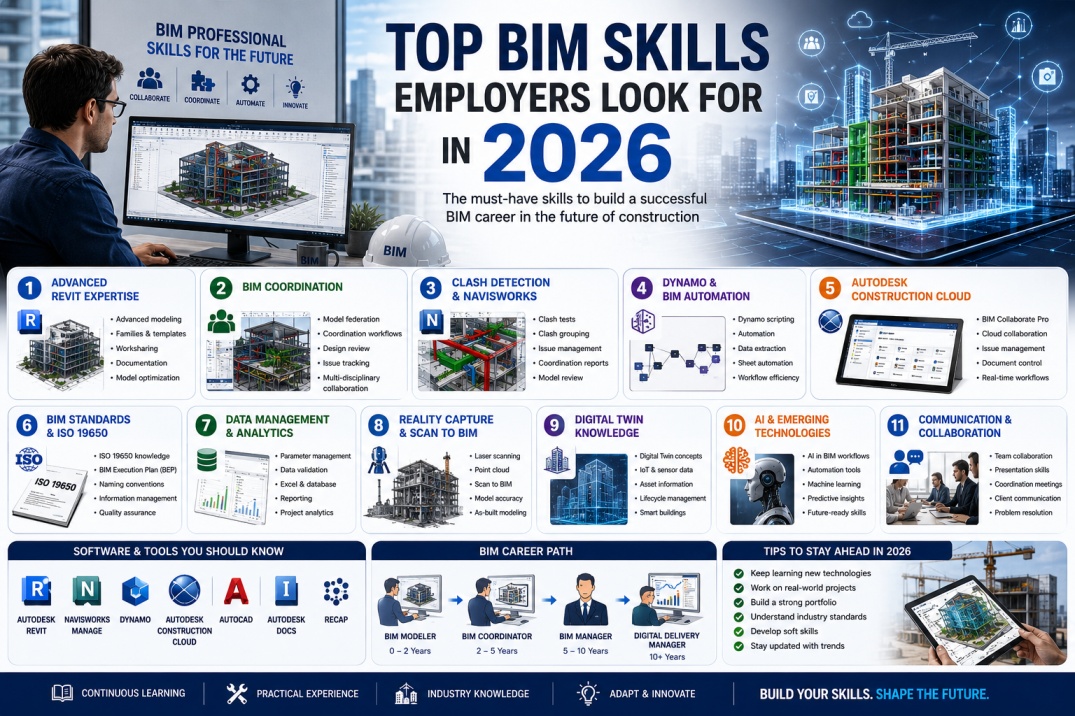
Building Information Modeling (BIM) has become one of the most important technologies in the Architecture, Engineering, and Construction (AEC) industry. As digital construction continues to expand, employers are seeking professionals who can contribute beyond basic modeling tasks. The BIM professional of 2026 is expected to possess technical expertise, collaboration skills, automation knowledge, and a strong understanding of modern construction workflows.
In previous years, learning Autodesk Revit alone was often enough to secure a BIM-related position. Today, the industry has evolved significantly. Organizations are increasingly adopting cloud collaboration platforms, AI-powered tools, digital twins, reality capture technologies, and advanced BIM standards.
As a result, employers are looking for professionals who can combine BIM software knowledge with strategic thinking and digital project delivery skills. Understanding these in-demand skills can help students, BIM Modelers, BIM Coordinators, and BIM Managers prepare for long-term career success.
Why BIM Skills Are Changing
The AEC industry is undergoing rapid digital transformation. Construction projects are becoming larger, more complex, and increasingly dependent on data-driven decision making.
Modern BIM workflows now include cloud collaboration, automation, reality capture, clash detection, project analytics, and Digital Twin technologies. Employers require professionals who can work within these advanced environments while maintaining project quality and efficiency.
The demand for BIM talent continues to grow globally, but employers are placing greater emphasis on specialized skills that support modern project delivery methods.
1. Advanced Revit Expertise
Autodesk Revit remains one of the most important BIM tools used across the industry. Employers continue to prioritize candidates with strong Revit skills because the software serves as the foundation for many BIM workflows.
However, basic modeling knowledge is no longer sufficient. Employers increasingly expect professionals to understand:
- Family creation and customization.
- Project templates.
- Shared parameters.
- Worksharing.
- View templates.
- Documentation workflows.
- Model optimization.
- Advanced scheduling.
Professionals who can efficiently manage complex Revit projects remain highly valuable.
2. BIM Coordination Skills
Coordination has become one of the most important aspects of BIM project delivery. Employers seek professionals who understand how different disciplines interact within a BIM environment.
BIM coordination involves:
- Model federation.
- Issue tracking.
- Design review processes.
- Coordination meetings.
- Multidisciplinary collaboration.
Professionals with coordination experience are often positioned for leadership opportunities within BIM teams.
3. Clash Detection and Navisworks
Clash Detection remains one of the most valuable BIM processes. Employers frequently look for candidates who can use Autodesk Navisworks Manage and similar coordination platforms.
Important skills include:
- Running clash tests.
- Clash grouping.
- Issue management.
- Coordination reporting.
- Model review workflows.
Strong clash detection expertise helps reduce project risks and improve construction efficiency.
4. Dynamo and BIM Automation
Automation is becoming increasingly important in BIM workflows. Dynamo allows Revit users to automate repetitive tasks and improve productivity.
Employers value professionals who can:
- Create Dynamo scripts.
- Automate parameter management.
- Generate sheets automatically.
- Perform data extraction.
- Develop workflow automation solutions.
As projects become more data-driven, automation skills will continue to increase in demand.
5. Autodesk Construction Cloud (ACC)
Cloud collaboration platforms have become standard across many BIM projects. Autodesk Construction Cloud enables teams to collaborate, share models, track issues, and manage project information from anywhere.
Employers increasingly expect BIM professionals to understand:
- ACC workflows.
- BIM Collaborate Pro.
- Cloud Worksharing.
- Issue management.
- Document control.
Experience with cloud-based BIM environments is becoming a major competitive advantage.
6. BIM Standards and ISO 19650
Organizations increasingly require BIM professionals who understand international BIM standards.
Knowledge of ISO 19650, BIM Execution Plans (BEP), naming conventions, information management, and quality assurance procedures helps ensure consistent project delivery.
Professionals who understand BIM governance often advance into coordination and management roles more quickly.
7. Data Management Skills
BIM projects generate large amounts of information. Employers seek professionals who can organize, analyze, and manage project data effectively.
Important skills include:
- Parameter management.
- Data validation.
- Excel integration.
- Database workflows.
- Reporting and analytics.
Data management is becoming increasingly important as BIM evolves into a broader information management process.
8. Reality Capture and Scan to BIM
Laser scanning and reality capture technologies are growing rapidly across the industry. Many organizations now require professionals who understand Point Clouds and Scan to BIM workflows.
Knowledge of tools such as Autodesk Recap, FARO Scene, and Point Cloud processing can significantly increase career opportunities.
Reality capture skills are especially valuable in renovation, infrastructure, and facility management projects.
9. Digital Twin Knowledge
Digital Twins are becoming one of the most important emerging technologies in the built environment.
Employers increasingly value professionals who understand how BIM models connect with operational data, sensors, and facility management systems.
Digital Twin expertise is expected to become a major career advantage over the next decade.
10. Artificial Intelligence and Emerging Technologies
AI is beginning to influence BIM workflows through automation, model checking, clash analysis, and design optimization.
Employers are looking for professionals who understand how AI tools can improve project delivery rather than viewing them as threats.
Professionals who combine BIM expertise with AI knowledge will likely remain highly competitive in the future job market.
11. Communication and Collaboration Skills
Technical skills alone are not enough. BIM professionals regularly work with architects, engineers, contractors, project managers, and clients.
Strong communication skills help teams:
- Resolve coordination issues.
- Conduct meetings effectively.
- Present project information.
- Support collaboration.
- Improve project outcomes.
Many employers consider communication skills just as important as technical expertise.
12. Problem-Solving and Critical Thinking
Every BIM project presents unique challenges. Employers value professionals who can analyze problems, evaluate alternatives, and develop practical solutions.
Problem-solving abilities become increasingly important as professionals advance from BIM Modeler to BIM Coordinator and BIM Manager roles.
How to Future-Proof Your BIM Career
Professionals who want long-term success should focus on continuous learning. The BIM industry changes rapidly, and staying current with technology trends is essential.
Recommended learning priorities include:
- Advanced Revit workflows.
- Dynamo automation.
- Navisworks coordination.
- Autodesk Construction Cloud.
- ISO 19650 standards.
- Reality capture.
- Digital Twins.
- AI-assisted BIM workflows.
Developing expertise across multiple areas creates stronger career opportunities and improves professional value.
Conclusion
The BIM professional of 2026 requires much more than software knowledge. Employers are increasingly seeking individuals who combine technical expertise, automation skills, coordination experience, data management capabilities, and strong communication abilities.
While Revit remains an essential foundation, emerging technologies such as AI, Digital Twins, Autodesk Construction Cloud, and Scan to BIM are reshaping industry expectations. Professionals who continue developing their skills and embracing innovation will be best positioned for future success.
As BIM adoption continues to expand globally, those who invest in learning these high-demand skills will remain valuable contributors to the evolving digital construction industry.