Can AI Replace BIM Modelers? The Future of BIM Careers in the Age of Artificial Intelligence
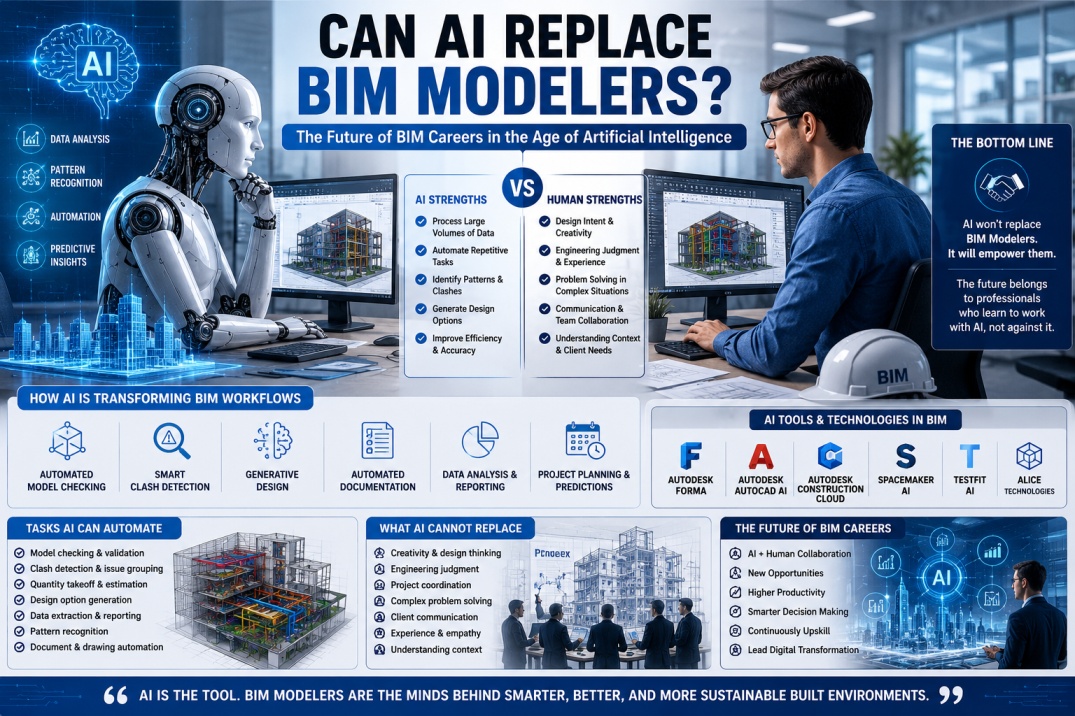
Artificial Intelligence (AI) is changing industries around the world, and the Architecture, Engineering, and Construction (AEC) sector is no exception. From automated design suggestions and data analysis to project planning and construction management, AI technologies are becoming increasingly integrated into modern BIM workflows.
As these technologies continue to evolve, many BIM professionals have started asking an important question: Can AI replace BIM Modelers?
The answer is more complex than a simple yes or no. While AI is capable of automating certain BIM tasks, the role of a BIM Modeler involves much more than creating geometry inside software. Understanding where AI excels and where human expertise remains essential can help professionals prepare for the future of the BIM industry.
Understanding the Role of a BIM Modeler
Before discussing AI's impact, it is important to understand what BIM Modelers actually do. BIM Modelers are responsible for creating, developing, and maintaining digital building models using software such as Autodesk Revit, Civil 3D, Tekla Structures, and other BIM platforms.
Their work includes interpreting construction documents, coordinating design requirements, developing BIM content, managing project information, resolving modeling challenges, and supporting project teams throughout design and construction phases.
A BIM Modeler is not simply a software operator. Successful BIM professionals combine technical knowledge, engineering understanding, construction awareness, and problem-solving abilities.
Why AI is Becoming Important in BIM
Modern BIM projects generate enormous amounts of data. Models contain thousands of building elements, parameters, schedules, drawings, and coordination requirements.
AI excels at processing large volumes of information, identifying patterns, and performing repetitive tasks much faster than humans. This makes BIM an ideal environment for AI-assisted automation.
Software developers and technology companies are investing heavily in AI-powered solutions that improve productivity and reduce manual effort within BIM workflows.
Tasks AI Can Already Automate
Several BIM-related tasks are already being automated through AI and machine learning technologies.
Automatic Data Analysis
AI can analyze large BIM datasets and identify inconsistencies, missing information, duplicate elements, and quality issues much faster than manual reviews.
Model Checking
AI-assisted model validation tools can automatically review BIM models for standards compliance, naming conventions, and project requirements.
Clash Detection Assistance
Traditional clash detection often produces thousands of results. AI can help prioritize clashes, group similar issues, and recommend resolution strategies.
Generative Design
AI can generate multiple design options based on project constraints such as area requirements, daylight performance, circulation paths, and space utilization.
Documentation Automation
Some AI tools can assist with sheet organization, schedule creation, annotation management, and repetitive documentation workflows.
These capabilities demonstrate that AI can significantly improve productivity for BIM teams.
What AI Cannot Easily Replace
Despite its impressive capabilities, AI still faces major limitations when compared to experienced BIM professionals.
Engineering Judgment
Construction projects often require decisions based on experience, engineering principles, regulations, and practical constraints. AI may suggest options, but human experts remain responsible for evaluating and approving solutions.
Design Intent Understanding
BIM Modelers frequently interpret architectural concepts, engineering requirements, and client expectations. Understanding design intent requires context and professional judgment that AI currently struggles to replicate.
Multidisciplinary Coordination
Successful BIM coordination requires communication between architects, engineers, contractors, owners, and project stakeholders. Human collaboration remains essential for resolving complex project issues.
Problem Solving
Every project presents unique challenges. BIM professionals regularly encounter situations that require creativity, adaptation, and practical decision-making beyond predefined rules.
Client Communication
Meeting with clients, explaining technical concepts, conducting coordination meetings, and managing project expectations are responsibilities that rely heavily on human interaction.
These skills remain difficult for AI systems to fully replace.
How AI Will Change BIM Modeler Jobs
Rather than replacing BIM Modelers entirely, AI is more likely to transform the nature of their work.
Routine and repetitive tasks will become increasingly automated, allowing professionals to focus on higher-value activities such as coordination, analysis, quality control, and decision-making.
The BIM Modeler of the future may spend less time manually placing elements and more time managing information, validating models, and leveraging AI-powered tools.
This shift is similar to how calculators changed accounting or how CAD transformed drafting. Technology eliminated some manual work but created new opportunities for skilled professionals.
New Skills BIM Professionals Should Learn
As AI becomes more integrated into BIM workflows, professionals should focus on developing skills that complement automation.
- Advanced Revit expertise.
- Dynamo and BIM automation.
- BIM coordination.
- Clash detection management.
- Data analysis.
- Construction technology knowledge.
- Digital Twin workflows.
- Project communication.
- BIM standards implementation.
- AI-assisted workflow management.
Professionals who embrace technology rather than resist it will be better positioned for long-term career success.
AI and the Future of BIM Careers
The future BIM workforce will likely include closer collaboration between humans and AI systems. Instead of replacing professionals, AI will serve as a powerful assistant that handles repetitive work and provides intelligent recommendations.
BIM Coordinators, BIM Managers, Digital Delivery Managers, and BIM Specialists who understand both BIM processes and AI technologies will become increasingly valuable.
Organizations will continue seeking professionals who can combine technical BIM expertise with leadership, coordination, and strategic thinking.
Industries Already Using AI in BIM
Many organizations are already integrating AI into their BIM workflows.
- Architecture firms using generative design.
- Engineering companies performing automated model checks.
- Contractors using AI-powered scheduling tools.
- Facility managers leveraging predictive maintenance systems.
- Owners developing Digital Twin platforms.
These examples demonstrate that AI adoption is accelerating across the AEC industry.
Should BIM Modelers Be Worried?
History shows that technology rarely eliminates entire professions overnight. Instead, it changes job requirements and creates new opportunities.
Professionals who continue learning and adapting generally benefit from technological advancements. BIM Modelers who develop automation skills, coordination expertise, and digital delivery capabilities are likely to remain in high demand.
The biggest risk is not AI itself but failing to adapt to changing industry expectations.
Conclusion
Can AI replace BIM Modelers? In the near future, the answer is no. While AI can automate repetitive tasks, analyze data, and improve productivity, it cannot fully replace the engineering judgment, coordination abilities, communication skills, and problem-solving expertise that experienced BIM professionals bring to projects.
Instead of replacing BIM Modelers, AI is transforming the profession by automating routine work and allowing professionals to focus on more strategic and valuable activities. The future belongs to BIM professionals who learn to work alongside AI and leverage its capabilities to deliver smarter, faster, and more efficient projects.
As BIM technology continues evolving, the most successful professionals will be those who embrace innovation, develop advanced skills, and position themselves as experts in both BIM and emerging digital technologies.