BIM Coordinator vs BIM Manager vs BIM Modeler: Roles, Responsibilities, and Career Path Explained
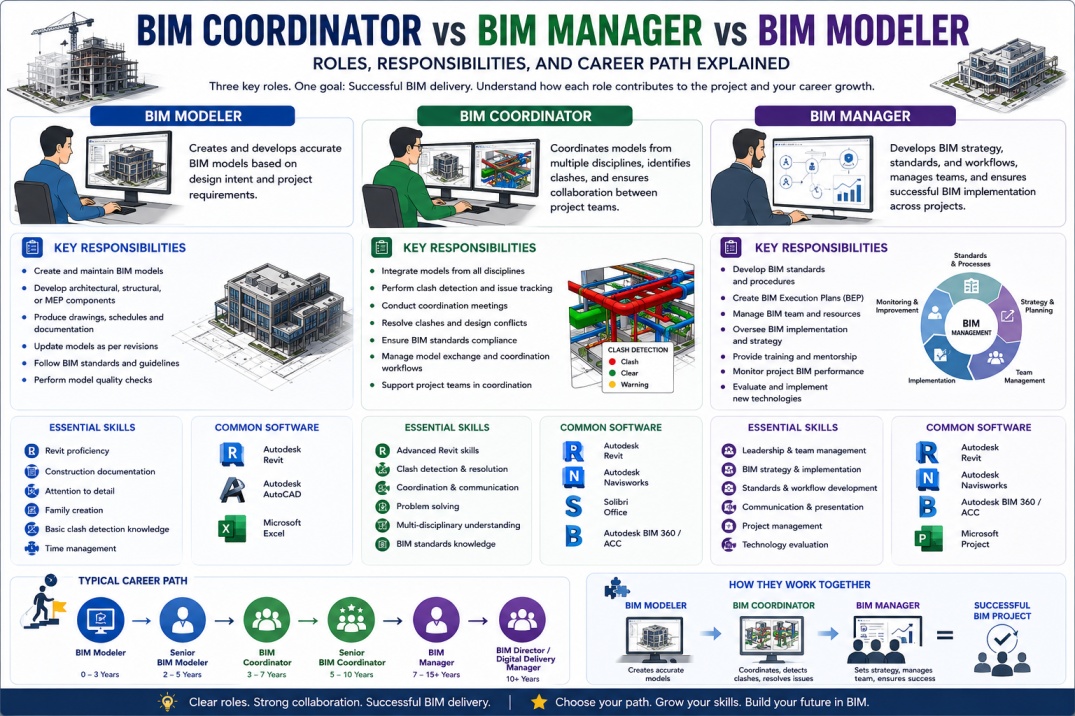
Building Information Modeling (BIM) has transformed the Architecture, Engineering, and Construction (AEC) industry by improving collaboration, coordination, and project delivery. As BIM implementation becomes standard across many projects worldwide, organizations increasingly rely on specialized BIM professionals to manage different aspects of digital project development.
Among the most common BIM-related job titles are BIM Modeler, BIM Coordinator, and BIM Manager. While these roles are connected and often work closely together, their responsibilities, skill requirements, and project involvement differ significantly.
Understanding these differences is important for students, fresh graduates, engineers, architects, and construction professionals who want to build a successful BIM career. Knowing how these roles interact can also help organizations structure BIM teams more effectively.
What is a BIM Modeler?
A BIM Modeler is typically responsible for creating and developing BIM models using software such as Autodesk Revit, Civil 3D, Tekla Structures, or other BIM platforms. BIM Modelers convert design information, sketches, drawings, and engineering requirements into detailed digital models.
The BIM Modeler serves as the foundation of the BIM workflow because accurate models are essential for coordination, documentation, scheduling, and construction planning.
Depending on their discipline, BIM Modelers may specialize in architectural modeling, structural modeling, mechanical systems, electrical systems, plumbing systems, or infrastructure projects.
Key Responsibilities of a BIM Modeler
- Create and maintain BIM models.
- Develop architectural, structural, and MEP components.
- Produce construction documentation.
- Update models according to design revisions.
- Follow company BIM standards and modeling guidelines.
- Create schedules and quantity takeoffs.
- Perform model quality checks.
- Support project coordination activities.
BIM Modelers spend most of their time working directly within modeling software and producing project deliverables.
Skills Required for a BIM Modeler
- Autodesk Revit proficiency.
- Understanding of construction drawings.
- Knowledge of BIM standards.
- Modeling accuracy and attention to detail.
- Basic clash detection understanding.
- Family creation and parameter management.
- Documentation skills.
For many professionals, the BIM Modeler position serves as the entry point into the BIM industry.
What is a BIM Coordinator?
As projects become more complex, coordination between disciplines becomes critical. This is where the BIM Coordinator plays a major role.
A BIM Coordinator focuses on integrating architectural, structural, and MEP models to ensure that all project disciplines work together efficiently. Rather than creating every model element, BIM Coordinators manage collaboration and identify conflicts before construction begins.
They act as the bridge between designers, engineers, contractors, and BIM Modelers.
Key Responsibilities of a BIM Coordinator
- Coordinate multidisciplinary BIM models.
- Perform clash detection reviews.
- Manage model federation processes.
- Conduct BIM coordination meetings.
- Track and resolve design conflicts.
- Monitor BIM standards compliance.
- Support project teams during coordination.
- Manage model exchange workflows.
BIM Coordinators often use software such as Navisworks, Autodesk Construction Cloud, Solibri, and Revit to review project coordination issues.
Skills Required for a BIM Coordinator
- Advanced Revit knowledge.
- Navisworks proficiency.
- Clash detection expertise.
- Problem-solving abilities.
- Communication skills.
- Understanding of multiple disciplines.
- Project coordination experience.
- BIM standards knowledge.
A BIM Coordinator typically has several years of modeling experience before moving into coordination responsibilities.
What is a BIM Manager?
The BIM Manager is responsible for overseeing BIM implementation at the project, department, or organizational level. Rather than focusing on day-to-day modeling activities, BIM Managers develop standards, establish workflows, manage BIM teams, and ensure successful BIM adoption across projects.
They play both a technical and strategic role within an organization.
BIM Managers help ensure that BIM processes align with company goals, client requirements, and industry standards.
Key Responsibilities of a BIM Manager
- Develop BIM standards and procedures.
- Create BIM Execution Plans (BEP).
- Manage BIM teams and resources.
- Oversee BIM implementation strategies.
- Provide training and mentorship.
- Monitor project BIM performance.
- Evaluate new BIM technologies.
- Ensure compliance with client requirements.
- Support digital transformation initiatives.
BIM Managers often work closely with senior leadership, project managers, and clients to establish BIM goals and project requirements.
Skills Required for a BIM Manager
- Advanced BIM knowledge.
- Leadership and team management.
- Project management skills.
- BIM standards expertise.
- Technology evaluation abilities.
- Strategic planning.
- Communication and presentation skills.
- Understanding of ISO 19650 and BIM standards.
Most BIM Managers have extensive experience as BIM Modelers and BIM Coordinators before moving into management roles.
Comparing the Three Roles
| Category | BIM Modeler | BIM Coordinator | BIM Manager |
|---|---|---|---|
| Primary Focus | Model Creation | Model Coordination | BIM Strategy |
| Main Software | Revit | Revit, Navisworks | Multiple BIM Platforms |
| Leadership Role | Limited | Moderate | High |
| Project Involvement | Model Development | Coordination | Project Oversight |
| Decision Making | Low | Medium | High |
| Experience Level | Entry to Mid-Level | Mid-Level | Senior Level |
Typical BIM Career Path
Most professionals progress through BIM roles gradually as they gain experience and technical expertise.
A common career path looks like:
BIM Modeler → Senior BIM Modeler → BIM Coordinator → Senior BIM Coordinator → BIM Manager → Digital Delivery Manager → BIM Director
This progression allows professionals to build technical knowledge before taking on greater coordination and leadership responsibilities.
Which Role is Best for You?
The ideal role depends on your interests and career goals.
If you enjoy creating detailed models and working directly in Revit, becoming a BIM Modeler may be the right choice. If you enjoy problem-solving, clash detection, and multidisciplinary collaboration, BIM Coordination may be more appealing.
Professionals interested in leadership, strategy, technology implementation, and team management often pursue BIM Management roles.
Each position offers valuable career opportunities and contributes significantly to successful BIM project delivery.
Future Opportunities in BIM Careers
The demand for BIM professionals continues to grow globally. Emerging technologies such as Digital Twins, Artificial Intelligence, Reality Capture, Scan to BIM, and Construction Automation are creating new career opportunities for BIM specialists.
Organizations increasingly seek professionals who can combine technical BIM expertise with leadership and digital transformation skills.
As BIM adoption expands, professionals who continuously develop their skills will remain highly valuable within the AEC industry.
Conclusion
Although BIM Modelers, BIM Coordinators, and BIM Managers all contribute to BIM project success, their responsibilities differ significantly. BIM Modelers focus on creating project models, BIM Coordinators manage project coordination and clash detection, while BIM Managers oversee BIM strategy, standards, and implementation.
Understanding these distinctions helps professionals plan their career development and enables organizations to build effective BIM teams. Whether you are just starting your BIM journey or planning your next career move, mastering the skills required at each level can open the door to exciting opportunities within the rapidly evolving BIM industry.