What is a Digital Twin in Design-Build Construction? Complete Guide for BIM Projects
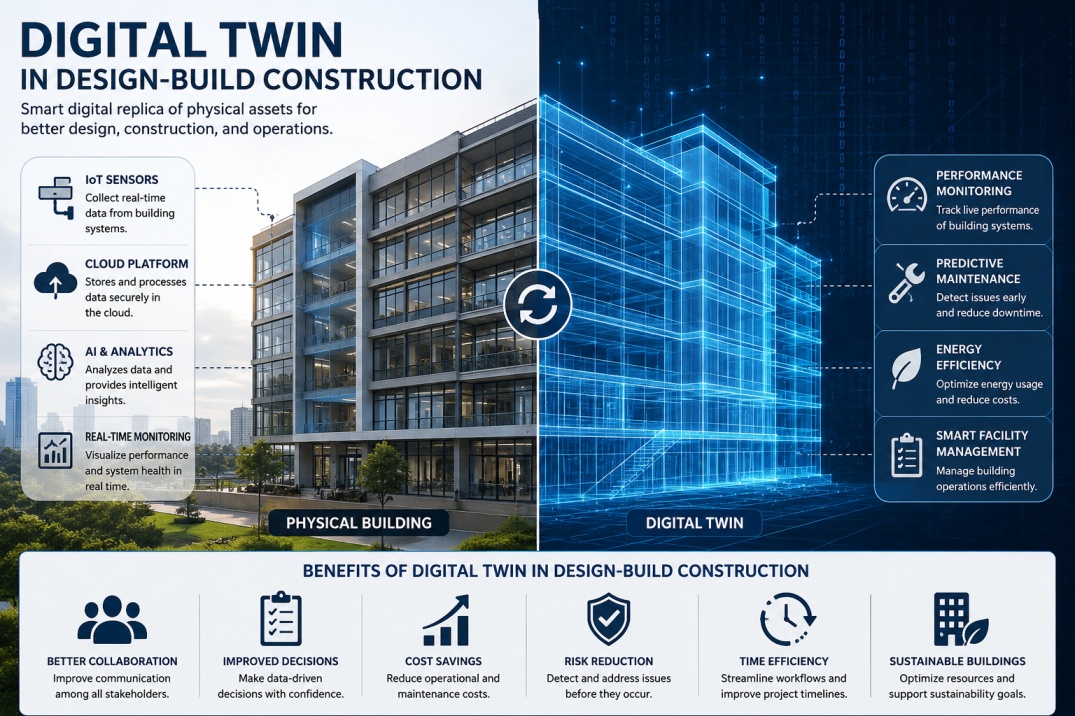
Digital Twin technology in design-build construction is transforming the way buildings are designed, constructed, operated, and maintained. It combines BIM, IoT sensors, Artificial Intelligence, cloud computing, and real-time analytics to create intelligent digital replicas of physical buildings and infrastructure systems.
A Digital Twin is not simply a 3D BIM model. It is a live virtual environment connected with real-world building data that continuously updates itself throughout the project lifecycle.
Digital Twins help architects, engineers, contractors, BIM professionals, and facility managers monitor building performance, improve operational efficiency, reduce maintenance costs, and make smarter project decisions.
As smart construction and digital transformation continue growing worldwide, Digital Twin technology is becoming increasingly important for modern design-build construction projects.
What is a Digital Twin in Design-Build Construction?
A Digital Twin is a digital representation of a physical building or infrastructure asset connected with real-time operational data.
It creates a continuous connection between the physical building and its digital environment using technologies such as:
- Building Information Modeling (BIM)
- IoT sensors
- Artificial Intelligence (AI)
- Machine learning
- Cloud computing
- Real-time analytics
Unlike traditional BIM models that mainly focus on design and documentation, Digital Twins continuously receive and analyze live data from the actual building.
This allows project teams to monitor system performance, identify operational problems, and improve decision-making throughout the building lifecycle.
How Digital Twin Technology Works
Digital Twin systems work by integrating BIM models with live building information collected from physical assets.
The process generally includes:
- Creating a detailed BIM model of the project
- Installing IoT sensors in building systems
- Collecting operational data continuously
- Processing data using AI and analytics tools
- Updating the digital model in real time
The Digital Twin becomes an intelligent virtual environment that reflects the actual condition and performance of the building.
Role of BIM in Digital Twin Technology
Building Information Modeling (BIM) forms the foundation of a Digital Twin system.
BIM provides:
- 3D geometry and visualization
- Building component information
- Construction documentation
- Coordination data
- Project information management
Digital Twins extend BIM capabilities by adding live operational data and intelligent analysis to the model.
This creates a more dynamic and responsive digital environment for project management and facility operations.
Main Components of a Digital Twin
A professional Digital Twin system generally includes several important components.
Physical Asset
- Buildings
- Infrastructure systems
- Mechanical equipment
- Electrical systems
- HVAC systems
Virtual BIM Model
- 3D BIM geometry
- Construction information
- Project documentation
- Asset management data
IoT Sensors and Devices
- Temperature sensors
- Humidity sensors
- Energy monitoring systems
- Occupancy sensors
- Equipment performance tracking
Cloud Computing Systems
- Data storage
- Real-time processing
- Cloud collaboration platforms
- Remote monitoring systems
Artificial Intelligence and Analytics
- Predictive maintenance
- Performance optimization
- Energy analysis
- Operational forecasting
- Automated reporting
Benefits of Digital Twins in Design-Build Construction
Digital Twin technology provides multiple advantages throughout the construction and operational lifecycle.
Improved Project Coordination
Real-time information improves collaboration between architects, engineers, contractors, and facility managers.
Better Building Performance
Digital Twins help optimize HVAC systems, lighting, ventilation, and energy usage based on actual operational conditions.
Predictive Maintenance
AI-powered analytics can detect equipment problems before failure occurs, reducing downtime and maintenance costs.
Improved Energy Efficiency
Continuous building monitoring helps reduce energy consumption and improve sustainability performance.
Smart Facility Management
Facility managers can monitor and manage building systems remotely using real-time dashboards and operational analytics.
Reduced Operational Costs
Early issue detection and optimized building performance help reduce long-term operational expenses.
Digital Twin vs BIM
| BIM | Digital Twin |
|---|---|
| Static building model | Live intelligent building model |
| Mainly used during design and construction | Used throughout entire building lifecycle |
| Manual updates | Automatic real-time updates |
| Focus on design coordination | Focus on operational performance and analytics |
| Limited operational monitoring | Continuous building monitoring |
Digital Twins expand BIM functionality by adding live operational intelligence and automated data analysis.
Applications of Digital Twin Technology
Digital Twins are increasingly used across multiple construction and infrastructure sectors.
- Commercial buildings
- Hospitals and healthcare facilities
- Industrial plants
- Airports and transportation systems
- Smart cities
- Infrastructure projects
- Facility management systems
- Energy optimization projects
Many large construction companies now use Digital Twins for advanced project monitoring and smart building management.
Role of AI and IoT in Digital Twins
Artificial Intelligence and IoT technologies are making Digital Twins more intelligent and efficient.
IoT devices continuously collect real-time building information, while AI analyzes large amounts of data to identify trends, detect anomalies, and predict future performance issues.
Machine learning systems improve predictive maintenance and building optimization capabilities over time.
These technologies help create smarter, more automated building management systems.
Future of Digital Twins in Construction
The future of Digital Twin technology is closely connected with smart infrastructure, sustainable construction, and digital transformation in the AECO industry.
Future trends include:
- AI-powered smart buildings
- Cloud-based BIM collaboration
- Smart city integration
- Advanced predictive analytics
- Automated facility management systems
- Energy-efficient infrastructure solutions
As technology adoption increases globally, Digital Twins will become an essential part of modern design-build construction workflows.
Conclusion
Digital Twin technology is revolutionizing design-build construction projects by combining BIM, AI, IoT, and real-time analytics into one intelligent digital ecosystem.
It helps architects, engineers, contractors, and facility managers improve project coordination, optimize building performance, reduce operational costs, and manage facilities more efficiently.
As smart construction technologies continue evolving, Digital Twins will play a major role in the future of intelligent buildings and digital infrastructure management.